Living the Christian life involves approaching God through prayer, praise and worship. On this site, we can find different ways people have and can enter into his presence.
Showing posts with label Presbyterian Church of Hopedale. Show all posts
Showing posts with label Presbyterian Church of Hopedale. Show all posts
Here's a copy of the order and the podcast of the worship service I led in the Presbyterian Church of Hopedale, Ohio on Sunday, December 27, 2020.Below was our order of worship.
Announcements
Our Call to Worship: Psalm 148
Leader: Praise the Lord! Praise the Lord from the heavens; praise him in the heights!
People: Praise him, all his angels; praise him, all his host!
Leader: Praise him, sun and moon; praise him, all you shining stars!
People: Praise him, you highest heavens, and you waters above the heavens!
Leader: Let them praise the name of the Lord, for he commanded and they were created.
People: He established them forever and ever; he fixed their bounds, which cannot be passed.
Leader: Praise the Lord from the earth, you sea monsters and all deeps, fire and hail, snow and frost, stormy wind fulfilling his command!
People: Mountains and all hills, fruit trees and all cedars! Wild animals and all cattle, creeping things and flying birds!
Leader: Kings of the earth and all peoples, princes and all rulers of the earth! Young men and women alike, old and young together!
People: Let them praise the name of the Lord, for his name alone is exalted; his glory is above earth and heaven.
Leader: He has raised up a horn for his people, praise for all his faithful, for the people of Israel who are close to him.
People: Praise the Lord!
Congregational Song
Prayer of Confession
Gracious God, we confess that we've sinned against you. We’re about to enter a new year, but instead to looking forward with hope and faith, we allow 2020 to shape our expectations and actions. As a result, we fail to claim the opportunities God has put before us. Merciful Lord, forgive us and help us trust you as we move forward.
Words of Forgiveness
Gloria Patri
Affirmation of Faith: The Apostle's Creed
I BELIEVE in God the Father Almighty, Maker of heaven and earth, And in Jesus Christ his only Son our Lord; who was conceived by the Holy Ghost, born of the Virgin Mary, suffered under Pontius Pilate, was crucified, dead, and buried; he descended into hell; the third day he rose again from the dead; he ascended into heaven, and sitteth on the right hand of God the Father Almighty; from thence he shall come to judge the quick and the dead. I believe in the Holy Ghost; the holy catholic Church; the communion of saints; the forgiveness of sins; the resurrection of the body; and the life everlasting. Amen.
The Prayers of the People: (followed by The Lord's Prayer)
Our Father, who art in heaven, Hallowed be Thy name. Thy kingdom come. Thy will be done on earth as it is in heaven. Give us this day our daily bread. And forgive us our debts, as we forgive our debtors. And lead us not into temptation, but deliver us from evil; For thine is the kingdom, and the power, and the glory, forever. Amen.
Here's the message I offered during the celebration services in the Presbyterian Church of Hopedale, Ohio on Sunday, November 29, 2020.
Mark 13:24-37 [Contemporary English Version]
In those days, right after that time of suffering,
“The sun will become dark,
and the moon will no longer shine.
The stars will fall,
and the powers in the sky will be shaken.”
Then the Son of Man will be seen coming in the clouds with great power and glory. He will send his angels to gather his chosen ones from all over the earth.
Learn a lesson from a fig tree. When its branches sprout and start putting out leaves, you know summer is near. So when you see all these things happening, you will know that the time has almost come. You can be sure that some of the people of this generation will still be alive when all this happens. The sky and the earth will not last forever, but my words will.
No one knows the day or the time. The angels in heaven don’t know, and the Son himself doesn’t know. Only the Father knows. So watch out and be ready! You don’t know when the time will come. It is like what happens when a man goes away for a while and places his servants in charge of everything. He tells each of them what to do, and he orders the guard to keep alert. So be alert! You don’t know when the master of the house will come back. It could be in the evening or at midnight or before dawn or in the morning. But if he comes suddenly, don’t let him find you asleep. I tell everyone just what I have told you. Be alert!
Reasons for Thanks
Of course, I don’t think I need to tell y’all that four days ago we observed Thanksgiving, our annual celebration of food, family and of course, football. Man, we all know that. Just like we all know that this year, well, it was different. I mean, I don’t know about y’all, but this was my first Thanksgiving in the middle of a pandemic. And I guess, for that reason, a lot of folks found it a little challenging to be all that thankful.
But I’ll tell you, I don’t think that’s totally fair. You see, I believe we have some genuine reasons for thanks. For example, the Presidential election is over, and regardless of how you feel about the outcome, I think the country could probably use a breather. I mean, roller coasters may be fun, but you can’t live on one 24/7. Using a term popularized by another Ohioan one hundred years ago, I think we’ll be returning to normalcy, and that’s certainly something for which we can be thankful. And it looks like a there’ll be a vaccine for COVID pretty soon, which means that maybe next year will be, again, a little more normal, and for that, I know I’ll be grateful. And on a more personal level, we all have families and friends. Babies are about to born and daughters are home from college. And this morning, we’re entering what’s called the Season of Advent, which means that Christmas is around the corner but still far enough away that it’s not stressing us out...yet.
And since this today sort of kicks off the season, we’re looking at same kind of passage that always falls on this particular Sunday. You see, as we begin to consider the first advent of Jesus, you know his birth, we always start by looking at his second advent, in other words, his return, his second coming. Of course, I recognize that for a lot of folks, this event seems to have more to do with Halloween than Thanksgiving. My gosh, with all this business about the sun and moon becoming dark and the stars falling from the sky, man, that causes fear, not thanks. And I haven’t even mentioned all those images from Revelation. But I’ll tell you, before we just buy that frightening farm and move on, let’s pause for just a minute, and I’ll tell you why. In spite of all that stuff that may scare the puddin out of us, I believe we can be genuinely thankful about the return of the Son of Man. In fact, that’s going to be our focus this morning. You see, we’re going to look at the passage we just read from Mark and consider three reasons we can be truly thankful as we think about the second advent of Jesus Christ. And I’ll tell you, each of these reasons can have a major impact on what we think and how we feel right now. And like I said, it all comes from these verses.
For example, first, I think this passage reminds us that God is in control of the future, and I’m talking about the future in general but also our future in particular. I mean, just listen to what Jesus said to his disciples:
In those days, right after that time of suffering,
“The sun will become dark,
and the moon will no longer shine.
The stars will fall,
and the powers in the sky will be shaken.”
Then the Son of Man will be seen coming in the clouds with great power and glory.
He will send his angels to gather his chosen ones from all over the earth. [Mark 13:24-27, CEV]
Now that’s what he said. And once we get beyond those very symbolic imagines that folks who study the Bible call apocalyptic, I think this is a pretty powerful statement about who’s actually in charge, and brothers and sisters, it’s not presidents or viruses or us. Man, it’s God, isn’t it? I mean, Jesus said that the Son of Man will be seen, not could be seen or may be seen or should be seen; no, he will be seen. And he going to be seen coming with great power and with divine glory. Brothers and sisters, that’s going to happen. And when it does, the Son of Man is going to send out his angels to gather up his chosen ones from all over the world. Now, I think it’s really important that he didn’t talk about gathering some and rejecting others. Instead, he’ll be gathering all those whom he has chosen, all those whom he loves, all those for whom he will die. And it’s sure not up to us to determine the basis for his decision much less to do the choosing ourselves. I’m telling you, without our permission, the Son of Man will come and without our help, the angels will gather his chosen ones. Why; because God is in control of the future.
And I’ll tell you something, if that doesn’t give us some hope as we move forward, I don’t know what will. You see, even though we might make all kinds of mistakes and even though, when we do, we’ll pay the consequences, the ultimate destiny of creation isn’t in our hands. Instead, it’s in the hands of the one who has power and glory. It’s like Paul said to the Romans, “The Lord told Moses that he has pity and mercy on anyone he wants to. Everything then depends on God’s mercy and not on what people want or do.” [Romans 9:15-16, CEV]. You see, our passage from Mark reminds us that God is in control of the future; therefore, we can move forward with hope. And in my opinion, that’s one very good reason for thanks.
And second, we can also be thankful that God is involved in the world right now. And again this is something we can see in these verses. Remember, Jesus said, “Learn a lesson from a fig tree. When its branches sprout and start putting out leaves, you know summer is near. So when you see all these things happening, you will know that the time has almost come. You can be sure that some of the people of this generation will still be alive when all this happens. The sky and the earth will not last forever, but my words will.” [Mark 13:28-31, CEV]
Of course, this is another one of those parables that has to do with plants growing, and a lot of them, well, frankly, they’re kind of confusing. But here, the point seems pretty obvious. When trees start turning green, we don’t need to have minored in biology to know that summer is coming. I mean, dah. And that’s exactly the way it is with the coming of the Son of Man and the gathering of his chosen ones. Man, it’s coming as sure as summer follows spring and Christmas follows Thanksgiving. It’s coming, and it’s closer today than it was yesterday. And I’ll tell you, whether we can see it or not, it is coming and do you know how we can be sure? Because when God makes a promise, man, it’s in concrete.
And you know, when we accept that, when we accept that God is present and active in the world right now, but more than that, that he’s moving creation toward it’s destiny, I think that can give us a lot of peace as we look around. As a matter of fact, when we decide to trust in God and his promises and when we decide to believe that the day is coming when the Son is going to come back and those whom he’s chosen will be gathered together, man, we’re going start recognizing signs that we may never have noticed before, signs that are frankly all around us. I mean, instead of being surrounded by a world that’s bleak and burdened and dying, man, we’re going to see the branches sprouting and putting out leaves. You see, this passage also reminds us that God is involved in the world right now; therefore, we can look around with peace. And in my opinion, that's another very good reason for thanks.
And third, and this may be the most exciting of all, we can be thankful that God’s given us the opportunity to be involved in his world as well. But that’s only going to happen, when we choose to get up and to do it. And I’ll tell you, I think that was point Jesus was making when he said, “No one knows the day or the time. The angels in heaven don't know, and the Son himself doesn't know. Only the Father knows. So watch out and be ready! You don't know when the time will come. It is like what happens when a man goes away for a while and places his servants in charge of everything. He tells each of them what to do, and he orders the guard to keep alert. So be alert! You don't know when the master of the house will come back. It could be in the evening or at midnight or before dawn or in the morning. But if he comes suddenly, don't let him find you asleep. I tell everyone just what I have told you. Be alert!” [Mark 13:32-37, CEV]
Now I think this is really important. I mean, since Jesus said that we can’t know the day or the time when all he described will happen (man, he doesn’t even know), let me ask you: Does it make sense to spend our lives worrying about it? And does it make sense to use our energy trying to interpret the signs? And does it make sense to waste the time we have right now sitting around, waiting for it to come? Does that make sense? Or should we claim the time we’ve been given as a gift? And should we put our talents and abilities to good use? And should we step out beyond ourselves and really live as though we believe that he meant it when “Jesus answered, ‘The most important one says: “People of Israel, you have only one Lord and God. You must love him with all your heart, soul, mind, and strength.” The second most important commandment says: “Love others as much as you love yourself.” No other commandment is more important than these.’” [Mark 12:29-31, CEV] Now, you tell me, since we can’t know exactly when it’ll end, how is the best way to use the lives we have?
Well, I think we all know the answer, right? Therefore, like it or not, we’ve got focus as we reach out. In other words, I think we’ve got a pretty good idea about how God wants us to live. And if we find ourselves in situations where the options are a little fuzzy and the right choice isn’t as clear as we’d like it to be, let me suggest a question we might want to ask ourselves before we make a final decision and take genuine action, and here it is: Does this show love for God and/or love for others? And if the answer is, “well, it doesn’t,” then we probably shouldn’t do it. Of course, this only works when we’re sincere in asking the question and honest in giving the answer. You see, in my opinion, this passage reminds us that God’s given us the opportunity to be involved in his world; therefore, we can reach out with focus. And for me, that’s the third reason for thanks found in this passage.
And I’ll tell you, I think that’s something we probably need to remember as we move past Thanksgiving and enter the Season of Advent. And even though this has been a challenging year so far, I believe we can be thankful as we consider the return of the Son of Man. You see, it reminds us that God is in control of the future; therefore, we can experience hope as we move forward. And it reminds us that God is involved in the world right now; therefore, we can know peace as we look around. And finally, it reminds us that God’s given us the opportunity to be involved as well; therefore, we can have focus as we reach out. And that’s going to be true regardless of presidents or viruses or all the other stuff that surrounds us.
Here's the message I offered during the celebration service in the Presbyterian Church of Hopedale, Hopedale, Ohio on Sunday, August 30. Matthew 16:21-28, Contemporary English Version
From then on, Jesus began telling his disciples what would happen to him. He said, “I must go to Jerusalem. There the nation’s leaders, the chief priests, and the teachers of the Law of Moses will make me suffer terribly. I will be killed, but three days later I will rise to life.”
Peter took Jesus aside and told him to stop talking like that. He said, “God would never let this happen to you, Lord!”
Jesus turned to Peter and said, “Satan, get away from me! You’re in my way because you think like everyone else and not like God.”
Then Jesus said to his disciples:
If any of you want to be my followers, you must forget about yourself. You must take up your cross and follow me. If you want to save your life, you will destroy it. But if you give up your life for me, you will find it. What will you gain, if you own the whole world but destroy yourself? What would you give to get back your soul?
The Son of Man will soon come in the glory of his Father and with his angels to reward all people for what they have done. I promise you that some of those standing here will not die before they see the Son of Man coming with his kingdom.
We’re Number Two
Now I’ve got to admit, I’m a little bummed today. You see, typically, on this particular Sunday morning I expect to be fat and sassy. As a matter of fact, from every pore in my body, I should literally be oozing college football. Every year, I look forward to this last weekend in August, because it represents the dawning of about four months of fatness and sassiness. I guess you could say that, right along with my wife, my daughter and oysters, I love college football.
Of course, as it is with almost everything else, this year is different. And even though I recognize that the NFL will be kicking off in a couple of weeks, I really prefer the college game, outside of the ridiculous way they handle overtime, but I digress. I love college football. But you know, it’s not just the game. It’s the whole environment. Now understand, when I lived in Indianapolis, I had Colt season tickets and so I enjoy what you could call the professional ambiance. But let’s get real, there’s nothing like college football. Good night nurse, the enthusiasm is off the charts. And with all those students crammed into a stadium, man, you might see or hear almost anything, with the exception of this. You’re not going to hear anyone chant, “We’re Number Two.” I can guarantee, those words you’ll never hear, because nobody in those stands wants to admit verbally that their team is anything other than number one. As they say, in football winning isn’t everything. It’s the only thing.
But you know, although no real fan wants to accept second place, I think that’s exactly what Jesus is telling us to do in the passage I just read. In other words, in this little story, I believe Jesus told this disciples then and tells his disciples right now that we should probably be offering a chant we’ll never hear at a Mountaineer or Buckeye game, “We’re number two.” And I’ll tell you, that’s going to be our focus this morning. And as we consider what he was saying to them and is saying to us, we’re going to answer three questions: first, with respect to Jesus, exactly where are we suppose to be; second, how do we get there; and third, why is that important for us to do. Now, that’s our game plan this morning.
Of course, the first question, well, I’ve pretty much answered it, haven’t I? With respect to Jesus, exactly where are we suppose to be? We’re suppose to be somewhere behind him, right? I mean, dah. But it’s not just me saying it, just remember what Matthew wrote: “From then on, Jesus began telling his disciples what would happen to him. He said, ‘I must go to Jerusalem. There the nation’s leaders, the chief priests, and the teachers of the Law of Moses will make me suffer terribly. I will be killed, but three days later I will rise to life.’ Peter took Jesus aside and told him to stop talking like that. He said, ‘God would never let this happen to you, Lord!’ Jesus turned to Peter and said, ‘Satan, get away from me! You’re in my way because you think like everyone else and not like God.’” [Matthew 16:21-23, CEV] Now that’s what happened.
And I’ve got to tell you, I don’t think it takes a rocket scientist to figure out why Peter did what he did and Jesus said what he said. I mean, to this point in the Gospel, it’s been pretty much peaches and cream, right? Jesus has been performing miracles and he’s been healing the sick and he’s been casting out demons right and left. His lessons have authority and his parables were engaging and his one sermon, you know, the one on the mount, wasn’t even boring. Jesus was a star. And Peter was certainly his right hand man. Good night, this had just happened: “Then Jesus asked them, ‘But who do you say I am?’ Simon Peter spoke up, ‘You are the Messiah, the Son of the living God.’ Jesus told him: Simon, son of Jonah, you are blessed! You didn’t discover this on your own. It was shown to you by my Father in heaven. So I will call you Peter, which means “a rock.” On this rock I will build my church, and death itself will not have any power over it. I will give you the keys to the kingdom of heaven, and God in heaven will allow whatever you allow on earth. But he will not allow anything that you don’t allow.” [Matthew 16:15-19, CEV] I’m telling you, both Jesus and Peter were riding high; therefore, it’s really not surprising that, when Peter heard Jesus shift from talking about how great the Kingdom of Heaven was going to be to how he was going to suffer and die, naturally he felt the need to offer some good PR advice, and that’s exactly what he did. Of course, in doing that, he was not only tempting Jesus to veer from his purpose, Peter was also forgetting his place as a disciple. You see, disciples of Jesus Christ, the Son of the living God, man, they don’t lead. And they don’t advise. And they don’t suggest. They simply follow, something that Peter had forgotten.
And you know, I think that’s something we forget ourselves from time to time. You see, sometimes I believe we think can take the Good News and make it better. I mean, what Jesus taught may be all well and good back in the day, but does that mean it can’t be improved? You see, we can make it more popular right now, by really hammering some commandments, while letting some others sort of slide. Just doing that will make it easier for folks to accept. And let’s get real, we all know that sacrifice doesn’t sell. For example, even though we’re running record deficits and the national debt is going up faster than any time in our history, who’s going to vote for a candidate who promises to raise our taxes and cut our services? I mean, dah. Now maybe raising and cutting them and you know who “they” are, now, that may be fine; but not us. You see, we like to be number one. But as it comes to Jesus, maybe we should be spending more time reading and praying and following than in making suggestions and offering advice and trying to lead. And so there you have it, question number one: with respect to Jesus, exactly where are we suppose to be? The answer: we’re number two, following him.
And you know, if that was the only question Jesus answered, I’m telling you, that would be nice to know information. But that’s not all he said. I mean, right after this little kerfuffle with Peter, this was what happened: “Then Jesus said to his disciples: If any of you want to be my followers, you must forget about yourself. You must take up your cross and follow me.” [Matthew 16:24, CEV] Now that’s what he said, and I think that answers our second question: how do we get there? How do we get behind and start following Jesus? In other words, how can we put ourselves as number two.
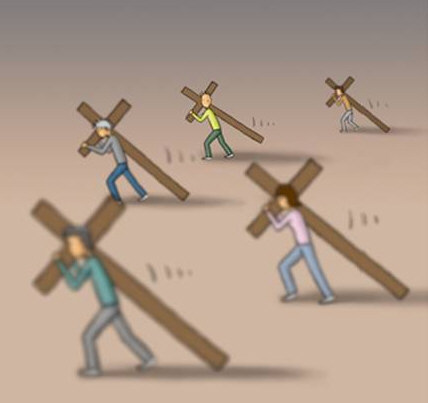
And you know, if the stuff about how Jesus was going to suffer was bad, this business about how disciples are suppose to sacrifice, man, that’s even worse. In fact, for Jesus it all came down to three steps. One, it involves forgetting about ourselves: forgetting about what we want, what we have, what we think, and what we believe we deserve. It’s about putting all that “me,” “my” and “mine” stuff on the back burner. That’s one. And then, two, it means taking up our cross. And let me be clear about this cross business; in the first century, crosses represented a whole lot more than sassy kids, patterned baldness or having to wear a mask during a pandemic. For those disciples, a cross was the ultimate symbol of sacrifice, and I’m talking about life and death. And that’s exactly what we’re called to carry. And that leads to step number three, the following part, in other words, doing what Jesus did and being guided by what he taught. That’s how we get behind him.
And I’m going to be straight with you, doing that isn’t easy, but then why should it be. Remember, a little later in the story, when a guy asked how he might have eternal life and after he said he’d done everything the Law required, “Jesus replied, ‘If you want to be perfect, go sell everything you own! Give the money to the poor, and you will have riches in heaven. Then come and be my follower.’ When the young man heard this, he was sad, because he was very rich.” [Matthew 19:21-22, CEV] Now that’s what I call turning from self. But of course, he wouldn’t say that to us, right? And as to following, what about this prophecy Jesus offered explaining how the Son of Man was going to judge the nations: “Then the king will say to those on his right, ‘My father has blessed you! Come and receive the kingdom that was prepared for you before the world was created. When I was hungry, you gave me something to eat, and when I was thirsty, you gave me something to drink. When I was a stranger, you welcomed me, and when I was naked, you gave me clothes to wear. When I was sick, you took care of me, and when I was in jail, you visited me.’” [Matthew 25:34-36, CEV] Now that’s some heavy lifting and following, right? But of course, he wouldn’t hold the United States to those standards, right? You see, in what he says to those disciples, I think he answers question number two: how do we get there? And I’m talking about how do we put ourselves behind Jesus?
And so with one and two answered, all we have left is question number three: Why is it important for us? Just listen to what Jesus said. “If you want to save your life, you will destroy it. But if you give up your life for me, you will find it. What will you gain, if you own the whole world but destroy yourself? What would you give to get back your soul? The Son of Man will soon come in the glory of his Father and with his angels to reward all people for what they have done.” [Matthew 16:25-27, CEV] Now that what he said.
And for those who heard him and those who still listen, well, I think there were two excellent reasons for following. I mean, on one hand, it determines what we do in the here and now. You see, if we’ve decided to do whatever it takes to save ourselves and the heck to everybody, man, we just may lose what’s most important. Of course, we may get a lot of stuff, you know, that kind of stuff that rust will eventually destroy and thieves break in and steal. In fact, we may get so much stuff we end up laying awake at night thinking about the bigger barns we’ll need to build in the future. Oh sure, stuff we’ll have. But understand the cost is high. I mean, to get all that stuff we may have to sacrifice a lot of our integrity and self-respect and self-esteem and frankly, some of our basic goodness and faith. But we’ll have plenty of stuff. You see, on one hand, the price may be pretty high in the short term.
On the other hand, though, it’s nothing like the price we may be paying in the future. I mean, remember that passage I just read about how Jesus praised those nations that fed the hungry and welcomed the strangers and cared for the sick. Well, he was just as harsh on those nations that didn’t. In fact, this was how the prophecy ended: “Then Jesus said, “Those people will be punished forever. But the ones who pleased God will have eternal life.” [Matthew 25:46, CEV] Now that’s what Jesus said. Of course, we also want to remember that, when talking about the rich young man I mentioned a little while ago, this was what happened: Jesus said to his disciples, “It’s terribly hard for rich people to get into the kingdom of heaven! In fact, it’s easier for a camel to go through the eye of a needle than for a rich person to get into God’s kingdom.” When the disciples heard this, they were greatly surprised and asked, “How can anyone ever be saved?” Jesus looked straight at them and said, “There are some things that people cannot do, but God can do anything.” [Matthew 19:23-26, CEV] You see, salvation is a gift, not a wage. Still, for my own peace of mind, I’d much rather be with the ones who can look at their lives and be confident of having eternal life than those whom Jesus said will be punished forever. And that’s really the answer to question number three, why is following Jesus important for us?
Now remember how I said that I was bummed this morning. Well, bummed isn’t as bad as crushed. You see, at 9:00 last evening, on ESPN, I watched Austin Peay play Central Arkansas in the Cramton Bowl. What do they say; any port in a storm? I think I’m still a little damp, but I did get my college football fix. And even though I can’t prove it, I seriously doubt that any of those 2,000 Governor or the Bear fans were chanting, “We’re number two,” even after Austin Peay scored on their play or Central Arkansas pulled it out at the end. Real fans just don’t do that. And yet that’s probably what we should be saying when we leave here this morning. You see, when you get right down to it, with respect to Jesus Christ, that’s exactly where we should be. And we can get there by shifting our focus from self to God and others. And we should probably do it because it’s going to make a difference in what we do right now and how we end up viewing our future. And now this we know. But we can save the chanting until we get home.
Here's the message I offered during the celebration service in the Presbyterian Church of Hopedale, Hopedale, Ohio on Sunday, August 9.
Matthew 14:22-33
Right away, Jesus made his disciples get into a boat and start back across the lake. But he stayed until he had sent the crowds away. Then he went up on a mountain where he could be alone and pray. Later that evening, he was still there.
By this time the boat was a long way from the shore. It was going against the wind and was being tossed around by the waves. A little while before morning, Jesus came walking on the water toward his disciples. When they saw him, they thought he was a ghost. They were terrified and started screaming.
At once, Jesus said to them, “Don’t worry! I am Jesus. Don’t be afraid.”
Peter replied, “Lord, if it is really you, tell me to come to you on the water.”
“Come on!” Jesus said. Peter then got out of the boat and started walking on the water toward him.
But when Peter saw how strong the wind was, he was afraid and started sinking. “Save me, Lord!” he shouted.
Right away, Jesus reached out his hand. He helped Peter up and said, “You surely don’t have much faith. Why do you doubt?”
When Jesus and Peter got into the boat, the wind died down. The men in the boat worshiped Jesus and said, “You really are the Son of God!”
Why did the boat cross the lake?
When I was a kid, we used to tell riddles. And one of the first ones I remember was this: “Why did the chicken cross the road?” And the answer, “to get to the other side.” Now, that’s it, not exactly a knee slapper. But I’ll tell you, that’s not necessarily the case when you change the answer. For example, suppose you ask me, “why did the chicken cross the road?” Now, if I watched Walker, Texas Ranger, I could say something like, “Man, if you saw Chuck Norris coming, you’d have crossed that road too!” Or, if I were a Star Trek fan, I’d say, “To boldly go where no chicken has gone before.” Or, if I wanted to be a little salty, I might say, “When I was your age, we didn’t ask why the chicken crossed the road. Someone told us that the chicken crossed the road, and that was good enough for us.” And those are just a few. I’m telling you, the possibilities are endless, and in my humble opinion, they’re all better than “to get to the other side.”
And you know, in a real way, we’re looking at similar question this morning. In other words, as we’re reading this story written by the Evangelist Matthew about Jesus walking on the water, I think it’s natural for us to ask this question, “why did the boat cross the lake?” And I’ll tell you, just like it was with the chicken question, I think there are some different possible answers that, when taken together, can really help us live our faith in the real world.
For example, if we ask the question, “why did the boat cross the lake?”, I think one possible answer is this: “So we can see exactly what kind of world we face.” Now for me, that’s a possibility, and I say that for two reasons. I mean, for one, there’s water all over the place in this passage. And although that might not mean much to us, the image of water was really important to the folks back in Matthew’s day. You see, for them, water represented chaos. And that just made sense. Boats were small and seas were wide and wild and unknown. And sometimes boats went out and didn’t come back. And I’ll tell you, if water represented chaos, the fact that, “by this time the boat was a long way from the shore. It was going against the wind and was being tossed around by the waves” [Matthew 14:24, CEV]; man, that’s really important. You see, according to Matthew, those disciples were in the middle of chaos. That’s one point. And two, they were also alone. I mean, where is Jesus when his disciples were in the boat? Matthew wrote, “Right away, Jesus made his disciples get into a boat and start back across the lake. But he stayed until he had sent the crowds away. Then he went up on a mountain where he could be alone and pray. Later that evening, he was still there.” [Matthew 14:22-23, CEV] Jesus was on a mountain, and the disciples were alone in a boat. Of course, that wasn’t totally true, because “...a little while before morning, Jesus came walking on the water toward his disciples.” [Matthew 14:25, CEV] But at that moment, the disciples couldn’t see it. From their perspective, not only was their little, bittie boat surrounded by chaos, they were out there alone. That was their situation, that was the kind of world they faced.
And I think that same reality applies to us. My gosh, speaking for myself, there are plenty of times when our world looks pretty chaotic and confused. And that’s only been compounded by the response to the death of George Floyd and a little thing called the cornavirus. And those are the big stories. Man, I think every family here has gone or is going through a little chaos in our own lives, whether it involves health issues or concern about children or a hot water heater going down this past Thursday (that’s a little bit of my own personal chaos.) Let’s get real, this kind of stuff happens to us all. And sometimes, as it relates to God, sometimes it sure seems like we’ve got to deal with the chaos alone. Now, I know a whole bunch of Christians would say having that kind of attitude is wrong, but give me a break, I don’t know why God doesn’t just heal all the racial divisions and wipe out COVID-19. And I don’t know why God doesn’t heal our health problems or our families or our hot water heaters. And I sure don’t know why God doesn’t cut a little slack for real believers like us and sort of put his thumb on the scale of justice in our favor and of course shower us with a little more of that health and wealth and happiness a lot of folks talk about. You see, those are some of things that cross my mind, stuff that I’ve gut a gut feeling those disciples were thinking as they faced all that water alone. You see, in the way he told the story, I think Matthew was showing us the kind of world we face. And that’s the first answer for why the boat crossed the lake.
But I’ll tell you, I think there’s another possible response that’s just as important. You see, why did the boat cross the lake, well, I believe another answer is this: “So we can understand exactly who we are in relationship with God.” And I think we can see that in the reactions of all the disciples and of Peter in particular. For example, think of the twelve; do you remember how they reacted when they saw Jesus on the water? According to Matthew, “When they saw him, they thought he was a ghost. They were terrified and started screaming. At once, Jesus said to them, ‘Don't worry! I am Jesus. Don't be afraid.’” [Matthew 14:26-27, CEV] You see, those guys in the boat doubted. They doubted their senses. They doubted that Jesus had come to them. They doubted and that led to fear. And I wish I could say that would change, you know, later in the story, but it didn’t. I mean, right at the end of the gospel, after the crucifixion and the resurrection, this was what Matthew wrote: “Jesus' eleven disciples went to a mountain in Galilee, where Jesus had told them to meet him. They saw him and worshiped him, but some of them doubted.” [Matthew 28:16-17, CEV] Now that’s what it says according to the Contemporary English Version, but trust me, the word “some” isn’t in the original Greek. Man, those disciples doubted right to the bitter end. That’s one thing the story shows. And two, I think it says a lot about what can happen when a person chooses to separate himself from his fellow disciples. Remember, “Peter replied, ‘Lord, if it is really you, tell me to come to you on the water.’ ‘Come on!’ Jesus said. Peter then got out of the boat and started walking on the water toward him. But when Peter saw how strong the wind was, he was afraid and started sinking. ‘Save me, Lord!’ he shouted.” [Matthew 14:28-30, CEV] Now that’s what Matthew wrote, and just think about what it means. For example, what happened when Peter got out of the boat and started walking away from his friends? He started to sink. And why did he start to sink? Because he became distracted by the winds and the water, in other words, by the chaos that surrounded him. I mean, not only did he doubt just like the rest, when he separated himself from them, the stuff happening all around got in the way of his attention, his focus on Christ.
And I’ll tell you, I believe both realities apply to us, and I’m talking about all of us. I mean, I think having a little or even a lot of spiritual doubt is, well, it’s just fact of life. In other words, it’s just something that we need to accept about ourselves. And even though there are plenty of Christians who equate doubt with a lack of faith, that was definitely not the view of Matthew. You see, doubt is only a problem when we deny it. In fact, I think this kind of self-denial leads believers to become righteously arrogant when they’re around others and yet, at the same time, spiritually guilty when they’re by themselves. We just may be doubters by nature, and that’s one thing we can understand about ourselves in this story. Just like we can also understand that we’re most vulnerable to distractions when we decide to separate ourselves from God’s people. And that’s why there’s no such thing as lone wolf Christians. We need one another for support and encouragement and love. But we also need our brothers and sisters to correct us when we’re wrong and give us a kick in the pants when we’re lazy. And that my friends is what the church is suppose to do. In fact, without this community, it’s easy to be overwhelmed by the values of the world and to sink into the chaos. You see, that’s just who we are. And that’s the second answer for why the boat crossed the lake.
And finally, I believe there’s another possible answer. “Why did the boat cross the lake?” “So we may know exactly how we can accomplish the work we’ve been called to do.” Another answer, and again, I say that based on the story itself. I mean, right here we’ve got a presentation of power and presence. For example, as it relates to power, Jesus was walking on the water, for crying out loud. And if water represented chaos, by walking on the water, Jesus was asserting his authority, wasn’t he? And who has authority over the water, the chaos? Listen to Job: “God alone stretched out the sky, stepped on the sea,...” [Job 9:8, CEV] And according to the psalmist, “You walked through the water of the mighty sea, but your footprints were never seen.” [Psalm 77:19, CEV] And the prophet Isaiah wrote, “Wake up! Do something, Lord. Be strong and ready. Wake up! Do what you did for our people long ago. Didn’t you chop up Rahab the monster? Didn’t you dry up the deep sea and make a road for your people to follow safely across?” [Isaiah 51:9-10, CEV] You see, when Jesus walked on the water, he was showing divine power and authority. And I’ll tell you, when he saved Peter and then got into the boat, Jesus was showing divine presence and love. Remember, after Peter cried out for help, Matthew wrote, “Right away, Jesus reached out his hand. He helped Peter up and said, ‘You surely don't have much faith. Why do you doubt?’ When Jesus and Peter got into the boat, the wind died down. The men in the boat worshiped Jesus and said, ‘You really are the Son of God!’” [Matthew 14:31-33, CEV] Did Peter doubt and show a lack of faith? He sure did. And were the disciples sure Jesus was a ghost and because of that, were scared? They sure were. And what did Jesus do? He saved Peter, got into the boat and stilled the storm. You see, in spite of what they did and how they felt, for them, Jesus was still Emmanuel, “God with us.”
And I’ll tell you something, he still is for us, and when we remember that, that’s how we can do the work we’ve been called to do. You see, as we go out into our chaotic world to disciple all nations, we have muscle backing us up. The one we serve had, has and will always have authority over the winds and the waves, over the problems and the pain, over the confusion that may threaten to overwhelm us and the chaos into which we can sink. Our Lord has power. And that power is with us right now. And I’ll tell you, the good news is that Jesus is present with us not because of us, but because of him and his promises. You see, even though the world may seem out of control and we might feel alone and even though there are plenty of times when we doubt and become distracted, these words that Jesus spoke to his disciples also apply to us. “Jesus came to them and said: I have been given all authority in heaven and on earth! Go to the people of all nations and make them my disciples. Baptize them in the name of the Father, the Son, and the Holy Spirit, and teach them to do everything I have told you. I will be with you always, even until the end of the world.” [Matthew 28:18-20, CEV] You see, that's just how we can do the work. And that's the third answer for why the boat crossed the lake.
Of course, like it was with the chicken, the most obvious answer to the question “why did the boat cross the lake?” is “to get to the other side. Dah.” But you know, given that there’s so much going on in this story, let’s not stop with the obvious, and I’ll tell you why. You see, when we look a little deeper, I think this story can help us see that our world can sure seem to be a chaotic and lonely place, even for Christians. And it can help us understand that despite how we like to see ourselves, we often doubt and are easily distracted. And finally, in spite of where we are and who we are, we can sill know that, given God’s power and presence, we can do the work we’ve been given to do. Now that’s what I think we can take from this story. And for me, that’s why the boat crossed the lake.
Here's the message I offered during the celebration service in the Presbyterian Church of Hopedale, Hopedale, Ohio on Sunday, August 2. Matthew 14:13-21 (Contemporary English Version)
After Jesus heard about John, he crossed Lake Galilee to go to some place where he could be alone. But the crowds found out and followed him on foot from the towns. When Jesus got out of the boat, he saw the large crowd. He felt sorry for them and healed everyone who was sick.
That evening the disciples came to Jesus and said, “This place is like a desert, and it is already late. Let the crowds leave, so they can go to the villages and buy some food.”
Jesus replied, “They don’t have to leave. Why don’t you give them something to eat?”
But they said, “We have only five small loaves of bread and two fish.” Jesus asked his disciples to bring the food to him, and he told the crowd to sit down on the grass. Jesus took the five loaves and the two fish. He looked up toward heaven and blessed the food. Then he broke the bread and handed it to his disciples, and they gave it to the people.
After everyone had eaten all they wanted, Jesus' disciples picked up twelve large baskets of leftovers. There were about five thousand men who ate, not counting the women and children.
A Great Show
Now I don’t know about y’all, but back in March, you know, when we were entering this pandemic, I watched more television than usual. I even learned how to binge. And since we got Netflix a couple of years ago, man, I had plenty to watch. And you know, it didn’t take me long to sort of separate the good shows from, well, the not so good.
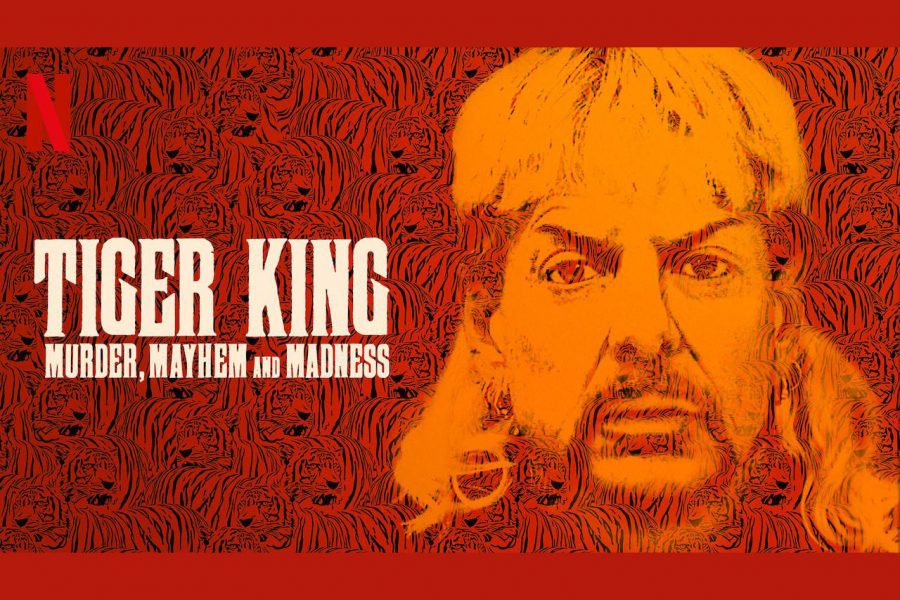
For example, since this all broke in March, one of the first shows I watched was Tiger King. Of course, I wasn’t alone. It was almost a cultural phenomena. Now if you’ve never seen it, I’ve got to tell you, it was a trip, and as Netflix goes, I think it was actually pretty good, and I’ll tell you why. First, it had a really engaging story, about all these men and women who owed private zoos full of these big animals, you know, like lions and tigers and bears. But more than that, my goodness, you had all these subplots that involved personality cults and murder for hire and burying a spouse under a septic tank...maybe. And I haven’t even scratched the surface. And to fit all that into eight, 45-minute episodes, now that makes for an engaging story. Now that’s one reason I think it was good. And second, Tiger King was filled with interesting characters, to say the least, starting with Joe Exotic, who looks exactly like his name, mullet and all, and who actually ran for President 2016. He didn’t win. And then there’s Carol Baskin who may or may not have fed her first husband to a tiger and who may or may not have been the focus of Joe’s hit. And of course, who could forget Doc Antle who ran this sort of culty thing with a bunch of young women and big cats and as I found out later, owned a private zoo back in Buckingham, Virginia, the little, bittie county where I taught school about fifteen years ago. And those were just the main characters. Man, we’ve got Joe’s three husbands and the guys feeding the animals old bologna donated by Walmart and the transsexual who got his/her arm bit off by a tiger and was back to work in a week. I’m telling you, you couldn’t make these characters up, and why would you. And third, the ending was actually pretty satisfying, with enough loose ends to make for a sequel. I mean, although he was convicted, did Joe really try to kill Carol as she was riding her bicycle and will he throw his hat into the 2020 presidential race? And will they eventually find the skeleton of Carol’s first husband and will her second husband stop either singing or wearing a caveman suit? And of course, will Walmart stop donating expired lunch meat after finding out that not all of it was eaten by the animals? Inquiring minds want to know. You see, these are some questions that could be answered in Tiger King, Part 2. And so, in my opinion, given the story, characters and ending, this was a pretty good show, at least in my opinion.
And you know, I think we’ve also got a pretty good show right here in the passage we just read, you know, about Jesus feeding the 5,000. For example, from my perspective, this is a really engaging story, one that’s just full of miracles but also a little bit of tension there in the middle. You see, we’ve got Jesus healing and then feeding a large crowd, but how he goes about the feeding business is in doubt right up to when he did it. And so, the story itself is interesting. And let’s get real, so are the characters. I mean, anything that involves Jesus is going to hold my attention. But right here, we’ve also got the crowds and of course, the disciples. And as to the ending, well, I think it’s pretty satisfying too and not just because everybody pretty much got their need met. I mean, even though we’ve got the immediate problem resolved in a pretty amazing way, as we leave the story, we’ve still got a lot to chew on. I mean, what happens next? And what does all this mean? And how does it relate to what we know is going to happen in the future? Now these are some questions that I know I have as I move on. And so, just like that Netflix series, we’ve got an engaging story, interesting characters and a satisfying ending right here in Matthew.
But I’ll tell you, in this little account about Jesus feeding the 5,000, one of only a hand-full of stories found in all four gospels, in my opinion, this is a whole lot better than just good. You see, I think we’ve got one great show going on in this passage, and I’ll tell you why. Right here, we have something that reminds of what Christianity is really all about. But even more than that, it also reminds us who we are as his disciples in this world that we’ve got, not necessarily the one we want. And for me, that’s what makes this show in the desert, the wilderness truly great. And I say that for three very specific reasons.
You see, first, the story we’ve been looking at reminds us of power, and in particular, the power that Jesus had and has. And I’m telling you, we see that right from the beginning, because after going across the lake, “when Jesus got out of the boat, he saw the large crowd. He felt sorry for them and healed everyone who was sick.” [Matthew 14:14, CEV] Let me say that again: “...everyone who was sick.” Of course, that’s not a surprise, man, according to Matthew, Jesus had been healing all over the place. But not only that, he’s also been casting out demons and stilling storms. In fact, in the very next passage, the disciples are going to see him walking on the water. Jesus has power. And if the healing wasn’t enough, a little bit later in this same story, he’s going to be feeding 5,000 people, not counting the women and children, with five loaves and two fish. But again, that’s not unusual, not for Jesus. In the very next chapter, he’s going to do this same kind of thing again, only this time for 4,000 with only “seven small loaves of bread and a few little fish.” [Matthew 15:34b, CEV] You see, when you take the healing and the feeding together, we’re talking about a lot of power on display here.
And you know, I think that’s something we need to remember, especially right now. Our whole world is really messed up, isn’t it? Let me give you an example. Somehow all this COVID-19 stuff has become political. I mean, just yesterday, I had someone tell me that it’s all a hoax that’ll be over after November. Of course, if that’s true, it means that every nation in the world decided to participate in a complex, global conspiracy, which seems to hard to pull off therefore pretty unlikely. Still, some folks see it all as political. But I’m here to tell you, it’s not political, because how we face it is actually spiritual. You see, we follow the one who healed the sick. And even though I don’t think that means we run around and do things that are reckless and stupid, the cornavirus is not stronger than Jesus Christ. And the same one who could feed over 5,000 people with a snack, still has authority over the world that he made. And I’ll tell you, we have a sign of that authority. Remember, before he fed all those people, “Jesus took the five loaves and the two fish. He looked up toward heaven and blessed the food. Then he broke the bread and handed it to his disciples, and they gave it to the people.” [Matthew 14:19b, CEV] You see, every time we celebrate communion, we’re reminded of the power shown in this story. And in my opinion, this reminder is the first thing that makes it truly great.
And second, I think what Jesus did here reminds of his compassion, and I’m talking about the compassion he feels toward regular people. For example, twice in this story, Jesus gave the crowd exactly what they needed, didn’t he? I mean, remember, according to Matthew, “when Jesus got out of the boat, he saw the large crowd. He felt sorry for them and healed everyone who was sick.” [Matthew 14:14, CEV] Now I think that’s important. I mean, he didn’t get on shore and start teaching or preaching. That’s something I may have done. Instead, because of what he felt, he worked to meet their needs. And I’ll tell you, by gum, he did it again, didn’t he? Matthew wrote, “That evening the disciples came to Jesus and said, ‘This place is like a desert, and it is already late. Let the crowds leave, so they can go to the villages and buy some food.’ Jesus replied, ‘They don't have to leave. Why don't you give them something to eat?’” [Matthew 14:15-16, CEV] Man, he saw they were hungry, and so what happened? “But they said, ‘We have only five small loaves of bread and two fish.’ Jesus asked his disciples to bring the food to him, and he told the crowd to sit down on the grass. Jesus took the five loaves and the two fish. He looked up toward heaven and blessed the food. Then he broke the bread and handed it to his disciples, and they gave it to the people.” [Matthew 14:17-19, CEV] Just like he did when he healed them, Jesus saw the need and did something about it.
And I’ll tell you, that’s something else I think we need to remember. And I say that for two reasons. One, maybe this reminds us that Jesus offers what we actually need but not necessarily what we think we need; therefore, maybe we should focus more on what we have and less on what we want. And maybe we’d be a whole happier and more content if we just accepted the love shown to us by Christ and made better use of what we have. Now that’s one. And two, when we truly recognize his compassion, that just might lead us to be more compassionate ourselves. I mean, just think about how Jesus fed that crowd. I’m telling you, he could have given them anything they wanted to eat. Or he could have filled their stomach without using food at all. My gosh, we already know he could have changed every stone in that desert into a loaf of bread. The Devil told us that. But he didn’t do it. Instead, he had his disciples distribute the food that they’d found in the crowd. In other words, his followers became the instruments of his compassion. And so it can be for us. We can demonstrate our love for Christ by actively working to meet the needs of others. We can be as compassionate as the one we encounter in these verses. And for me, that’s the second reason this story is great.
And finally, if we choose to listen, this miracle in the wilderness can remind us of the abundance that Jesus offers. I mean, just remember about how the story ends. Matthew wrote, “After everyone had eaten all they wanted, Jesus’ disciples picked up twelve large baskets of leftovers. There were about five thousand men who ate, not counting the women and children.” [Matthew 14:20-21, CEV] Now just think about what that means. Everybody ate all that they wanted. In other words, there was enough to meet the entire need. But not only that, there were twelve large baskets of leftovers. Of course, twelve is an important number. It represents the twelve tribes of Israel. And so, not only did Jesus heal everyone in that large crowd who was sick, he also made sure that every man, woman and child there had enough food to be satisfied and then some. In this passage, both his power and compassion was abundant.
And brothers and sisters, so can ours. Now, I recognize that our resources are limited and we’ve been called to be good stewards of what God has given us. Still, I don’t think God wants us to be stingy with what we have. Rather, I believe he wants us to be generous with what we’ve been given. And that applies to us as individuals as well as communities, even nations. And if we want to know what that means in practical terms, just listen to what Jesus said in the last lesson he gave his disciples before his arrest. He said, “When the Son of Man comes in his glory with all of his angels, he will sit on his royal throne. The people of all nations will be brought before him, and he will separate them, as shepherds separate their sheep from their goats. He will place the sheep on his right and the goats on his left. Then the king will say to those on his right, ‘My father has blessed you! Come and receive the kingdom that was prepared for you before the world was created. When I was hungry, you gave me something to eat, and when I was thirsty, you gave me something to drink. When I was a stranger, you welcomed me, and when I was naked, you gave me clothes to wear. When I was sick, you took care of me, and when I was in jail, you visited me.’ Then the ones who pleased the Lord will ask, ‘When did we give you something to eat or drink? When did we welcome you as a stranger or give you clothes to wear or visit you while you were sick or in jail?’ The king will answer, ‘Whenever you did it for any of my people, no matter how unimportant they seemed, you did it for me.’” [Matthew 25:31-40, CEV] You know, I think you could say that this passage reminds us to take the abundance we’ve been given and to pass it forward. And along with the power and the compassion, I’m telling you, Jesus feeding the 5,000 is one great show.
And believe that’s something Tiger King is not. You see, even though the story is engaging and the characters are interesting and the ending is satisfying, there’s really nothing great about this eight-part freak show. And the only reminder it offers is the reminder to thank God everyday that you haven’t had your arm bitten off by a tiger or that you’re not buried under the septic tank...maybe. But it’s completely different with this passage we have from Matthew, because along with being engaging and interesting and satisfying, it also reminds us of the power Jesus has and the compassion Jesus feels and the abundance Jesus offers, three things that can not only shape how we see him, but also how we see ourselves and others.
Here's the message I offered during the celebration service in the Presbyterian Church of Hopedale on Sunday, May 17. John 14:15-21
“If you love me, you will keep my commandments.
“And I will ask the Father, and he will give you another Advocate, to be with you forever. This is the Spirit of truth, whom the world cannot receive, because it neither sees him nor knows him. You know him, because he abides with you, and he will be in you.
“I will not leave you orphaned; I am coming to you. In a little while the world will no longer see me, but you will see me; because I live, you also will live. On that day you will know that I am in my Father, and you in me, and I in you.
“They who have my commandments and keep them are those who love me; and those who love me will be loved by my Father, and I will love them and reveal myself to them.”
If We Love Him
Let me ask y’all a question: have y’all ever heard of something called a “conditional sentence”? Well, don’t worry if you haven’t. It’s one of those things that we use all the time without knowing what it’s officially called. You see, a conditional sentence always has two parts. In one part, usually beginning with the word “if,” there’s a condition. And then, in the other part, there’s a consequence. For example, I might say, “If it rains (the condition), the picnic will be canceled (the consequence).” Pretty cool, right?
And you know, as we go through this pandemic, conditional sentences have become a big deal. For instance, if you want to go certain place, you have to wear a mask. And if you want to eat out, it’s got to be take out and brought back home. And of course, the big one we hear all the time, if this lock-down continues for too much longer, it’s going to be devastating to the economy, but if it’s ended too soon, more people will get sick and die. It’s like being caught between a rock and a hard place.
And I’ll tell you, all this corona conditional jazz has hit the Rudiger family close to home. As I mentioned last week, Maggie is in the class of 2020; therefore, she’s suppose to be graduating from Weir High this month. But that’s all up in the air thanks to COVID-19. For example, a couple of weeks ago, we got a robo call from the Superintendent of the Hancock County schools saying that, if the governor and the state department of health give their approval, graduation would still be held on Wednesday, May 27, but they’d do it on the athletic field with a limited attendance. In other words, if these conditions are met, a modified graduation will take place. You see, that’s a conditional sentence.
And you know, we’ve got another one right here in the passage we’re looking at this morning. I mean, remember what we talked about last week. Jesus told two of his disciples that he was about go somewhere, and if they wanted to know where he was going, they’d need to trust him, something that they didn’t seem able to do. Well, right after he said all that, Jesus dropped on them a conditional sentence, didn’t he? He said, “If you love me, you will keep my commandments.” [John 14:15, NRSV] Now, at this point, there was no way for Thomas and Philip to know what he meant by “my commandments.” But Jesus would remedy that in just a minute, when he said, “If you keep my commandments, you will abide in my love, just as I have kept my Father’s commandments and abide in his love. I have said these things to you so that my joy may be in you, and that your joy may be complete. This is my commandment, that you love one another as I have loved you.” [John 15:10-12, NRSV] And so the command was clear, “that you love one another I have loved you.” And just so they wouldn’t get the idea that this love was just emotional, Jesus continued: “No one has greater love than this, to lay down one’s life for one’s friends. You are my friends if you do what I command you.” [John 15:13-14, NRSV] And so, there you have it. Both the condition and the consequence were clear. If those disciples really loved Jesus, they would love one another in the same way he will soon show his love for them. If they loved him, that’s what he expected them to do.
But you know, even though the expectation was straight forward, actually doing it would be really challenging. I mean, as I think everybody knows, loving one another in the same sacrificial way Jesus loved us, man, that’s going to be tough. And I think Jesus knew it, and that was why he made them this two-fold promise. I mean, first, he said, “And I will ask the Father, and he will give you another Advocate, to be with you forever. This is the Spirit of truth, whom the world cannot receive, because it neither sees him nor knows him. You know him, because he abides with you, and he will be in you.” [John 14:16-17, NRSV] In other words, to help them obey his command to love, the disciples were going to receive something Jesus called a παρακλητος, an Advocate, someone who would challenge them when necessary and comfort them when needed and advocate for them all the time. Put another way, after Jesus left, he’d send another figure that would do for them same kind of thing that he’d done while he was with them. That was the first promise. And second, Jesus promised that he would come back, if only for a short time, to do it, you know, to give them the Spirit. And I think that was what he was getting at when he said, “I will not leave you orphaned; I am coming to you. In a little while the world will no longer see me, but you will see me; because I live, you also will live. On that day you will know that I am in my Father, and you in me, and I in you.” [John 14:18-20, NRSV] Now that’s what he said. And you know, that was exactly what happened. Now, we’re going to talk about this again when I’m back here on Pentecost, but listen to how John described the coming of the Holy Spirit, the Spirit of truth: “When it was evening on that day, the first day of the week, and the doors of the house where the disciples had met were locked for fear of the Jews, Jesus came and stood among them and said, ‘Peace be with you.’ After he said this, he showed them his hands and his side. Then the disciples rejoiced when they saw the Lord. Jesus said to them again, ‘Peace be with you. As the Father has sent me, so I send you.’ When he had said this, he breathed on them and said to them, ‘Receive the Holy Spirit. If you forgive the sins of any, they are forgiven them; if you retain the sins of any, they are retained.’” [John 20:19-23, NRSV] And so, according to Jesus, if you love me, what will you do? “You will keep my commandments.” And if that’s what you decide to do, how will Jesus help? After leaving, he’ll come back and bring to you another Advocate, the Spirit of Truth, the Holy Spirit. And so they have the what and the how.
And the why, why should they show their love for Jesus by keeping that commandment to love others as they’ve been loved, just listen: “They who have my commandments and keep them are those who love me; and those who love me will be loved by my Father, and I will love them and reveal myself to them.” [John 14:21, NRSV] You see, if they chose to claim the Spirit and to obey the Son, not only would they be showing their love for him, they’d also be sharing in both the love of the Father and Son. And that just makes sense, because remember, in the passage we looked at last week, “Jesus said..., ‘Have I been with you all this time, Philip, and you still do not know me? Whoever has seen me has seen the Father. How can you say, “Show us the Father”? Do you not believe that I am in the Father and the Father is in me? The words that I say to you I do not speak on my own; but the Father who dwells in me does his works. Believe me that I am in the Father and the Father is in me; but if you do not, then believe me because of the works themselves.’” [John 20:19-23, NRSV] And so, according to John, Jesus was clear in what he said to those disciples. “If you love me, then you will keep my commandments.” [John 14:15, NRSV]
And I’ll tell you, I think that same conditional sentence applies to us. You see, if we’re serious about loving Jesus, I mean, if we’re willing to do something more than just talking about what we feel and if we’re ready to let the rubber hit the road and to start showing that loving our Lord and Savior is a heck of a lot more than just making a bunch of promises that ain’t worth a bucket of spit unless we actually do something, if that’s where we are, then we know exactly what to do, right? Man, we need to keep his commandments. In other words, we need to roll up our sleeves and to do something about it, maybe putting into action some other words Jesus offered, this time in the Gospel of Matthew: “for I was hungry and you gave me food, I was thirsty and you gave me something to drink, I was a stranger and you welcomed me, I was naked and you gave me clothing, I was sick and you took care of me, I was in prison and you visited me... Truly I tell you, just as you did it to one of the least of these who are members of my family, you did it to me.” [Matthew 25:35-36 & 40b, NRSV] We can do that. Or maybe it means working into our character some of these words of Paul: “Love is patient; love is kind; love is not envious or boastful or arrogant or rude. It does not insist on its own way; it is not irritable or resentful; it does not rejoice in wrongdoing, but rejoices in the truth. It bears all things, believes all things, hopes all things, endures all things.” [1 Corinthians 13:4-7, NRSV] I’ll tell you, just like those disciples, we know exactly what to do, if we really do love Jesus.
But you know, unlike them, we’ve got a leg up on the how, and I’ll tell you what I mean. Remember how, after the resurrection, Jesus breathed on the disciples and they received the Holy Spirit, the Advocate, the Spirit of truth. Well, I want you to believe this: that Spirit is alive and well and living in the town of Hopedale and in Weirton and even in Pittsburgh. And that Spirit is still doing what Jesus said that it would do. A little later in this same conversation, Jesus will say, “Nevertheless I tell you the truth: it is to your advantage that I go away, for if I do not go away, the Advocate will not come to you; but if I go, I will send him to you. And when he comes, he will prove the world wrong about sin and righteousness and judgment: about sin, because they do not believe in me; about righteousness, because I am going to the Father and you will see me no longer; about judgment, because the ruler of this world has been condemned.” [John 16:7-11, NRSV] You see, we live after he returned; therefore, we’re actually in a better condition than those disciples who had to wait. I’m telling you, if we’re serious about showing our love to Jesus by keeping the commandment to love others, we can claim that Spirit which is in us right now. And that’s how we can do it.
And as to the why, why would we want to show that we love Jesus by loving one another as he loved us; well, I don’t think that’s changed at all. You see, when we do that, not only will we be showing our love for him, we’ll also be able to share in his love for us. As a matter of fact, when we make the decision to be actively loving, we might actually begin to really understand what Jesus was getting at when he said, “And just as Moses lifted up the serpent in the wilderness, so must the Son of Man be lifted up, that whoever believes in him may have eternal life. For God so loved the world that he gave his only Son, so that everyone who believes in him may not perish but may have eternal life. Indeed, God did not send the Son into the world to condemn the world, but in order that the world might be saved through him.” [John 3:14-17, NRSV] I’m telling you, that’s why we do it.
And you know, all this flows from that one conditional sentence, “If you love me, then you will keep my commandments.” [John 14:15, NRSV] Of course, just because the condition and the consequence are clear, that doesn’t mean things will work out the way we want. Remember, right at the beginning, I was telling you about how the superintendent said that, if the governor and the state department of health gave their approval, graduation would still be held on Wednesday, May 27? Well, Friday we got a call telling us that neither the governor nor the department of health gave it’s approval; therefore, Maggie’s graduation is now scheduled for July 27. That’s just the way it is, the condition wasn’t met. And I think that’s also true of that statement in the passage we read. You see, even though we may believe that when we keep the commandment offered by Jesus, we move closer to God, and even though we may believe that, through the Spirit, Jesus has given us the ability to do it, and even though we may believe that keeping the commandment means loving one another in the same way as we’ve been loved by Jesus himself, man, even though the consequence is clear, the condition is still in doubt. And you know, that’s going to be the case until we prove the condition is true and we decide if we really do love him.
Here's a copy of the bulletin and the podcast of the worship service I led in the Presbyterian Church of Hopedale, Ohio on Sunday, February 23, 2020. We focused on how we might be changed by understanding the story of the Transfiguration. We also celebrated communion during the service.