Living the Christian life involves approaching God through prayer, praise and worship. On this site, we can find different ways people have and can enter into his presence.
Below is the text and recording of the message I preached on Easter morning at Rimersburg Presbyterian Church on Easter Sunday, April 9.
Matthew 28:1-10 [Contemporary English Version]
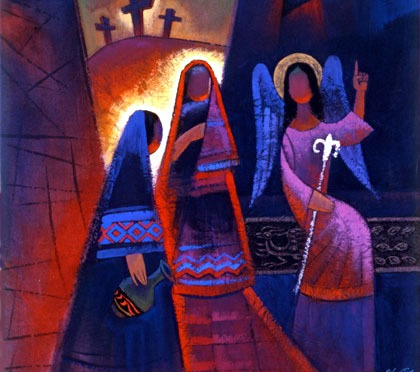
The Sabbath was over, and it was almost daybreak on Sunday when Mary Magdalene and the other Mary went to see the tomb. Suddenly a strong earthquake struck, and the Lord’s angel came down from heaven. He rolled away the stone and sat on it. The angel looked as bright as lightning, and his clothes were white as snow. The guards shook from fear and fell down, as though they were dead.
The angel said to the women, “Don’t be afraid! I know you are looking for Jesus, who was nailed to a cross. He isn’t here! God has raised him to life, just as Jesus said he would. Come, see the place where his body was lying. Now hurry! Tell his disciples he has been raised to life and is on his way to Galilee. Go there, and you will see him. This is what I came to tell you.”
The women were frightened and yet very happy, as they hurried from the tomb and ran to tell his disciples. Suddenly Jesus met them and greeted them. They went near him, held on to his feet, and worshiped him. Then Jesus said, “Don’t be afraid! Tell my followers to go to Galilee. They will see me there.”
Mary and the Other Mary
You know, it’s interesting; sometimes the strangest things can pass through your mind at the oddest times. For example, this past Friday, when I was thinking about the passage that we just looked at and after I read that “the Sabbath was over, and it was almost daybreak on Sunday when Mary Magdalene and the other Mary went to see the tomb [Matthew 28:1, CEV],” do you know what I started to think about? I started to think about that old television show from, I think, the eighties called Newhart and particularly about those three brothers who owned the café right next to the Stratford Inn.
Now, if you remember the series you know exactly who I’m talking about, the “Anything for a Buck” guys. But if you’ve forgotten about the show, let me tell you what I’m talking about. Newhart was a situation comedy in which Bob Newhart owned a hotel, well it was really more like a “bed and breakfast” kind of place. And on the program, there were these three really dirty and scraggly guys who were almost always together. Now they were brothers and only one talked. And every time they came into a room, the one who talked would always, and I mean always, say the same thing. He’d say, “I’m Larry, and this is my brother Daryl and my other brother Daryl.” Now that’s what he’d say. And I’ve got to tell you, when I read, “Mary...and the other Mary,” bang, I was right back at the Stratford.
And you know, when it comes to the resurrection, well, I think the women are often seen as a little bit like those two guys. In other words, I think most people who know the story would say that they have a secondary role at best. I mean, with angels coming down and guards freezing up and of course Christ himself passing by, often the women kind of get lost in the shuffle. And although they may not rise, or probably better drop to the level of Daryl and the other Daryl, as we think about what we might learn from Jesus being raised from the dead, I believe in the minds of a lot of folks, Mary and the other Mary are pretty close.
But you know, I think that’s a real shame, and I’ll tell you why. In my opinion, not only did those women play a central role in the story itself, they also carried a message that can absolutely change our lives, if we let it. You see, when we really pay attention to what those two women did and consider what they became, I think we’re going to find a source of hope and peace we may never have known before.
You see, when we take a good, hard look at those two women, I think we’re going to recognize that, first, they really became the first witnesses to the resurrection, didn’t they? In other words, they became the first human beings to tell others about something that absolutely changed the world: that through the power of the Almighty God, Jesus Christ was raised from the dead. I mean, just think about what Matthew wrote. After they’d come to the tomb and after the stone was rolled away and after the guards were frozen in their tracks literally, the angel said to them,
Don’t be afraid! I know you are looking for Jesus, who was nailed to a cross. He isn’t here! God has raised him to life, just as Jesus said he would. Come, see the place where his body was lying. Now hurry! Tell his disciples he has been raised to life and is on his way to Galilee. Go there, and you will see him. This is what I came to tell you. [Matthew 28:5a-7, CEV]
Now that’s what the angel said.
And do you remember what those two women did? Again, according to Matthew, “the women were frightened and yet very happy, as they hurried from the tomb and ran to tell his disciples.” [Matthew 28:8, CEV] Now, I’ve got to tell you, reading this gives me chills. You see, they did exactly what the angel told them to do. And man, this is important, because when they ran and told Peter and James and John and all the rest exactly what had happened, they were doing a whole lot more than just passing on information. They were sharing a message that is at the very heart of the gospel, the good news. My gosh, they were bearing witness to the most important event in human history, and I’ll tell you why. The resurrection isn’t just about an empty tomb or a dead body that came back to life; that had been done. It’s not even a happy ending to the story that had taken a dark turn, no, it’s a whole lot more than that. You see, it’s God giving his stamp of approval on everything that Jesus said and everything that he did during his life. But it’s even more than that. It’s a reminder that just like Christ was raised from the dead, take it to the bank, one day so will we. It’s like the Apostle Paul wrote to the Corinthians:
But Christ has been raised to life! And he makes us certain that others will also be raised to life. Just as we will die because of Adam, we will be raised to life because of Christ. Adam brought death to all of us, and Christ will bring life to all of us. But we must each wait our turn. Christ was the first to be raised to life, and his people will be raised to life when he returns. [1 Corinthians 15:20-23, CEV]
Now that’s what Paul wrote, and I’ll tell you, if that doesn’t give you hope as you live in the present and look to the future, I don’t know what will. You see, regardless of what happens in our world and regardless of what happens in our lives, right here and right now, we can say that after we die, God will raise us to new life, to eternal life. Man, we can shout it from the rooftops with absolute confidence. Why? Because that’s exactly what he did with his son and our savior. Jesus was the first one who was raised, but we know others will follow. And I’m telling you, that’s what Easter’s all about and that’s the message the two Marys carried to the disciples. You see, they were the first witnesses to the resurrection; that’s the first thing those women became.
But that’s not all. Second, they also became genuine agents of reconciliation. In other words, they also let those disciples know that in spite of their past failures, in spite of their prior weaknesses, my goodness, in spite of the fact that, on a scale from one to ten, as loyal followers of Christ, the twelve probably earned something like a two, Jesus hadn’t given them up. You see, that was also part of the message of those women.
But to understand how radical this was, I think it’s important to remember that by the end of his time here on earth, Jesus had twelve followers left, and do you remember what happened to them? One betrayed him. One denied him. And the rest ran away. I mean, if you were applying to be a disciple, this is not the kind of stuff you’d put on a resume. And because of that, I think we’d all agree that given what had happened, Jesus had every right to be a little ticked by the faith of his closest so-called followers. I know I’d be. And yet, when he met those women as they were on their mission, do you remember what Jesus said? According to Matthew, “Then Jesus said, ‘Don’t be afraid! Tell my followers to go to Galilee. They will see me there.’” [Matthew 28:10, CEV] “Tell my followers.” Now personally, I find that amazing. In spite of the fact that they’d been pretty much wash outs as disciples, Jesus still called them his followers, and that was something else those women were told to share.
And I’ll tell you, we need to hear that message too. I mean, we need to hear that no matter what we did in the past, no matter how many times we’ve disappointed the folks around us or how many examples of our own failures people can throw up to us, Christ still sees us as his followers, as his brothers and sisters and is always ready to welcome us back when we return to the fold. You see, the Apostle Paul was right when he wrote that “nothing in all creation can separate us from God’s love for us in Christ Jesus our Lord!” [Romans 8:39b, CEV]; therefore, we’re just going to have to live with the fact that God loves us. He loves us when we’re good and sitting in church on Easter morning but he also loves when we’re at our worst on Monday afternoon. I’m telling you, we need to hear that, because right there we can find peace as we live in the present. You see, they were agents of reconciliation, and that’s the second thing the Marys were.
Now in a few minutes, the service will be over, and we’ll be back to the same old, same old. But you know, as we all leave church this Easter morning, the one day we most clearly focus our attention on the resurrection of Jesus, along with the guards and the angel and of course the risen Christ, let’s also spend a little time thinking those two women, and I’m talking about Mary and the other Mary. I mean, let’s remember how they were the very first witnesses to the resurrection and how they were both agents of reconciliation. You see, right now, let’s all decide that we’re going to claim this, because I’ll tell you, if we do, starting today we’ll have a new sense of hope as we look into the future and a new feeling of peace as we live in the present. And you know, I don’t have to watch an old rerun of Newhart to know that.
Below is the text and a recording of the sermon I preached at Rimersburg Presbyterian Church, on Sunday, January 15.
John 1:29-42 [Contemporary English Version]
The next day, John saw Jesus coming toward him and said:
Here is the Lamb of God who takes away the sin of the world! He is the one I told you about when I said, “Someone else will come, who is greater than I am, because he was alive before I was born.” I didn't know who he was. But I came to baptize you with water, so that everyone in Israel would see him.
I was there and saw the Spirit come down on him like a dove from heaven. And the Spirit stayed on him. Before this I didn't know who he was. But the one who sent me to baptize with water had told me, “You will see the Spirit come down and stay on someone. Then you will know that he is the one who will baptize with the Holy Spirit.” I saw this happen, and I tell you that he is the Son of God.
The next day, John was there again, and two of his followers were with him. When he saw Jesus walking by, he said, “Here is the Lamb of God!” John's two followers heard him, and they went with Jesus.
When Jesus turned and saw them, he asked, “What do you want?”
They answered, “Rabbi, where do you live?” The Hebrew word “Rabbi” means “Teacher.”
Jesus replied, “Come and see!” It was already about four o'clock in the afternoon when they went with him and saw where he lived. So they stayed on for the rest of the day.
One of the two men who had heard John and had gone with Jesus was Andrew, the brother of Simon Peter. The first thing Andrew did was to find his brother and tell him, “We have found the Messiah!” The Hebrew word “Messiah” means the same as the Greek word “Christ.”
Andrew brought his brother to Jesus. And when Jesus saw him, he said, “Simon son of John, you will be called Cephas.” This name can be translated as “Peter.”
Like Selling a Green Tractor
Now I doubt that any of y’all know this about me, but I grew up in the South, specifically Virginia. Of course that meant, I went to a southern university and later, to Union Theological Seminary, right there in the center of the universe, Richmond, Virginia. And as we used to say growing up, you can’t go farther south than Richmond. Anyway, right after I graduated from seminary, I went just about as far from the south as you can go. You see, my first church was out in Fairview, Montana. It was right in the Yellowstone River Valley, there on the border with North Dakota, a place where, according to any good North Dakotan, “The cold keeps out the riff-raff.” Well, it didn’t keep out this southern boy.
And I’ll tell you, when I first moved out there, I learned three things quickly. One, you never, and I mean never, joke about rain. Unfortunately, I learned that the hard way. And two, if you really want to fit in, you’ve gotta eat this horrible Norwegian delicacy called lutefisk which is cod that’s been cured in lye that you’ve got to let soak or it’ll kill you. And this soaking business is really important, because it takes every bit of flavor out of the fish. I’ll tell you, it’s like eating packing peanuts, dipped in butter. I think Vikings took lutefisk with them on their boats, you know, to scare off their enemies. Now that’s two. And three, when it comes to loyalty and devotion, there’s something more important than country, there’s something more important than family, there’s something more important than religion, my gosh, there’s something even more important than sports. Among those farmers in eastern Montana and western North Dakota, you were either green or red or blue. You see, empires may rise and fall, spouses may come and go, and God may speak in different ways, at different times, but when it comes to farm equipment, you were either a John Deere or an International Harvester or a Ford man, as was your father and his father and as will be your son and his son, Amen. It was a little like hemophilia or being a Steelers fan; this was passed from one generation to the next. I’ll tell you, that’s just the way it was.
Well, in my congregation out in Fairview, Dean Carlsen was a John Deere salesman, and a good one at that. And I knew Dean pretty well. In fact, he chaired the committee that called me. Anyway, one day, I was talking to Dean about his work, and in particular, how he got new customers in an area where loyalties ran so deep. And I remember him telling me that it was really pretty simple. He said he didn’t use a lot of fancy material, you know, brochures and stuff like that, and he never ran down the competition. Instead, his goal was simply to get the guy into the store and then show him exactly what John Deere equipment could do. That’s all. But if he could do that, according to Dean, he had a real chance for a sale.
And you know, as I was thinking about it, that sure seems to be the same kind of thing that’s going on in the passage we just read from the Gospel of John. I mean, think about it, wasn’t that what John the Baptist was doing, when he pointed to Jesus and called him “Lamb of God who takes away the sin of the world” and then told his disciples about how the Spirit had come down on him like a dove from heaven? And you know, wasn’t that also what Andrew did, when he went and found his brother Simon and told him that “We have found the Messiah;” we have found the Christ? Sure it is. In fact, in a very real way, they were all doing exactly what Jesus suggested to those two disciples of John who asked him, “Rabbi, where do you live?” and he said to them, “Come and see!” “Come and see,” now that’s what Jesus said to those two guys who were deciding whether or not to follow him and that’s what John the Baptist and Andrew suggested as they directed attention to Christ. And you know, that’s really what Dean used to do when he was selling tractors. In essence, he would simply say to potential customers, “Come and see.”
And you know, I think that’s exactly what we’ve been called to do as disciples of Jesus Christ. In other words, we’re simply called to do two things, neither of which is rocket science but that doesn’t mean that they may not require a little bit of work on our part. And let me tell you what they are.
You see, first, as individual Christians and as a congregation, I think we’re called to invite people to come: to come to this place, to come and celebrate the power and the grace of God, to come and experience the presence and the love of Christ. You see, as people who believe that John was right on the mark when he looked at Jesus and said, “Here is the Lamb of God who takes away the sin of the world!”, we’re called to invite folks to come, especially those who don’t know and now I’m talking about those on the outside. And I’ll tell you, I think this is something we all know we’re supposed to be doing. As a matter of fact, I think it’s something we want to do. And why wouldn’t we? My goodness, if I had an extra ticket to a Steelers game, I would certainly ask somebody to come with me, and coming to church is certainly better than any Steeler game, right? Well, maybe that’s going a little too far, but y’all know what I’m saying, right?
And so I think we all know we should be doing this stuff, but how, now that’s another question, and not necessarily an easy one. You see, from where I stand, for us to really start inviting folks to come, it seems to me that we’re going to overcome both our culture and frankly ourselves. I mean, let’s get real, we live in a society where talking about religion is generally not done, at least, not in polite company. Well, if we’re going to start inviting folks, we’re going to have to change that. And I think we’re also going to have to overcome some of the stuff within ourselves that sort of holds us back, and I’m thinking about our personal shyness and the idea that a lot of Christians have, that what we believe is a private matter, not to be shared with others and of course the fear that when it comes to our own personal relationship with Jesus, well, we really don’t have much to share at all, something that kind plagues a lot of Presbyterians I know. I’ll tell you, if we’re ever going to do what we’ve been called to do, we’ve either got to overcome this stuff or maybe better yet fix it. But in my opinion, that’s only half the battle.
You see, to invite people to come, I think we’ve also got to become as inviting as we can possibly be. In other words, we really have to want to do it and to believe that lives can be changed for those who accept our invitation. For example, we need to believe that we have something special to share with the world: that regardless of who we are or what we’ve done we are loved by the creator of the universe and will be saved by the son and are being led by the Holy Spirit. And I’ll tell you, if that doesn’t motivate us to be inviting, frankly, I don’t know what will. And as a congregation, man, we can invite others by working hard as we can to make this church the kind of place where people can really find a home, a place where folks can feel a part of worship because it touches them in a special way, whether they were raised here or walked through those doors for the very first time today, a community that’s so focused on sharing the grace of Jesus Christ to folks who live on the other side of the stained glass that it’s willing to do something that no Presbyterian congregation really likes to do; it’s willing to change. You see, as we overcome the obstacles and become the men and women God has called us to be, we’ll be able to invite folks to come. But that’s just half the call.
Because second, I think we’re also called to make sure the people who come have something to see when they get here, and right now I’m talking about the ability to see Jesus Christ and the joy and hope that he offers those who believe. And I’ll tell you, they’ve got to be able to see this right here, because let’s face it, we can be inviting as all get out, but if we fail to provide the right stuff for people to see, we’ve done absolutely nothing for the kingdom of God. And we can have all kinds of gimmicks designed to get people through those doors, but they’re meaningless if we don’t offer anything that’s substantial and real for them to receive once they’re inside. Of course, there’s a lot of ways we can help people see Christ. I mean, we can do it through our worship and our music. And we can do it through the way we treat one another and the way we relate to them. And we can do it through our willingness to put ourselves second even though we’d prefer to be first, but not because it’ll make us look good, rather because it’s the right and Godly thing to do.
But regardless of how we choose to do it, I think it all begins with a decision: a decision to take a long, hard and even critical look at who we are and what we’re doing and then ask one simple question: How can we communicate the love and grace of God better than we are right now? Man, that’s got to be our focus, not membership, not attendance, not even giving, but helping people realize that God loves them and that Christ died for them and that the Holy Spirit can inspire every man, woman and child in Clarion County. And if we’re serious about people seeing Jesus through us, that focus can become a part of everything we do. Why? Because we’ve been called to give folks the truth that they can see when they get here. And for me, that’s the other half.
You know, Dean had a lot of success just encouraging potential customers to come over to the store and see the equipment. And so did Andrew when he encouraged his brother Peter to come with him and see the messiah and John the Baptist when he pointed toward Jesus and told his own disciples to see the Lamb of God. And you know what, the minute we recognize that we’ve been called to invite people, all people, to come and to give them the best chance possible to see Jesus Christ right here, I think we can be successful too, because when you get right down to it, being Christian disciples, well, it’s, at least a little bit, like selling a green tractor.
Here's the message I offered during the celebration services in the First United Presbyterian Church of Brilliant, Ohio and First United Presbyterian Church of Mingo Junction, Ohio on Sunday, May 30, 2021.
John 3:1-17 [Contemporary English Version]
There was a man named Nicodemus who was a Pharisee and a Jewish leader. One night he went to Jesus and said, “Sir, we know that God has sent you to teach us. You could not work these miracles, unless God were with you.”
Jesus replied, “I tell you for certain that you must be born from above before you can see God’s kingdom!”
Nicodemus asked, “How can a grown man ever be born a second time?”
Jesus answered:
I tell you for certain that before you can get into God’s kingdom, you must be born not only by water, but by the Spirit. Humans give life to their children. Yet only God’s Spirit can change you into a child of God. Don’t be surprised when I say that you must be born from above. Only God’s Spirit gives new life. The Spirit is like the wind that blows wherever it wants to. You can hear the wind, but you don’t know where it comes from or where it is going.
“How can this be?” Nicodemus asked.
Jesus replied:
How can you be a teacher of Israel and not know these things? I tell you for certain that we know what we are talking about because we have seen it ourselves. But none of you will accept what we say. If you don’t believe when I talk to you about things on earth, how can you possibly believe if I talk to you about things in heaven?
No one has gone up to heaven except the Son of Man, who came down from there. And the Son of Man must be lifted up, just as that metal snake was lifted up by Moses in the desert. Then everyone who has faith in the Son of Man will have eternal life.
God loved the people of this world so much that he gave his only Son, so that everyone who has faith in him will have eternal life and never really die. God did not send his Son into the world to condemn its people. He sent him to save them!
Sermon Title: DOS
Today is another one of those days that’s really important for two very different reasons. You see, when we check out our regular calendars, this is the Sunday right before Memorial Day, one of the most important days in our civic year. I mean, this is the one day set aside to remember those who’ve died for our country. And I’ll tell you, in my opinion, that’s a sacrifice that we should never forget. Now that’s what it says on the calendar we have on our desks.
But of course, around the church, that’s not the only calendar we use, because just like we talked about last week, there’s also what’s called the Calendar for the Church Year. And according that particular calendar, today is Trinity Sunday. Now in case you don’t know, it’s always the Sunday right after Pentecost, and it’s set aside to remember what it means for us to say that our one God has three persons: Father, Son and Holy Spirit. And I’ll tell you, I believe that’s also something important for us to discuss at least once a year, and I’ll tell you why. Not only is it one of the most important concepts in the Christian faith, in fact, it actually separates us from the other great monotheistic religions, like Judaism and Islam, it’s also something that’s a little bit fuzzy for even life-long believers. And so, I think I’m safe in saying that this morning, we’re looking at two pretty important days.
And for that reason, to help us understand what this Trinity business is all about and since Memorial Day is tomorrow, I’m going to bring in something with which the folks who’ve served in the military, with the exception of the Air Force, might be familiar, and I’m talking about the letters MOS. Now, in case you don’t know what those letters mean, they stand for “Military Occupational Specialty.” In the Air Force, the letters are AFSC, and they stand for “Air Force Specialty Codes.” But I’ll tell you, they mean the exact same thing. You see, if you’re in the Army or the Navy or the Marines, your MOS is your job, you know, your rank and your specialty. In other words, it indicates what you’re suppose to be doing.
And this morning, we’re going to take that concept and apply to God and in particular to God the Father and God the Son and God the Holy Spirit. And instead of calling it MOS or AFSC, we’re going to talk about each of their DOS, you know, their Divine Occupational Specialty. Now that’s going to be our focus. And I hope by the end of our time together we’ll have a better understanding not only of what each person in Trinity did and does, but also why that “specialty” might be important to us. And we’re going to use the passage we read from John as sort of a foundation for our discussion.
Of course, if we’re going to look at each member of the Trinity, it probably makes sense to start with the Father. I mean, we usually think in terms of “Father, Son and Holy Spirit,” and so where we’re going to start almost seems preordained. And you know, when we take the one generally called the first person in the Trinity and think about his DOS, I believe that I’m safe in saying that God the Father loves. That’s what he does. That’s his job. Of course that’s not all he does, but to understand the Father, I really believe we need to start with his love. I mean, according to John, “God is love” [1 John 4:8a, CEV] for crying out loud. And I’ll tell you, I think we can certainly see that in the passage we just read. Remember, Jesus said to Nicodemas, “God loved the people of this world so much that he gave his only Son, so that everyone who has faith in him will have eternal life and never really die. God did not send his Son into the world to condemn its people. He sent him to save them!” [John 3:16-17, CEV]. You see, the Father loves.
And I’ll tell you, when we use other scripture to unpack what this love is all about, I think it has at least two really important characteristics. You see, first, I believe that the Father’s love is transforming. In other words, it actually changes who we are and how we can relate, but not just to God, also with one another. I mean, just listen to what John wrote in his first letter: Think how much the Father loves us. He loves us so much that he lets us be called his children, as we truly are. But since the people of this world did not know who Christ is, they don’t know who we are. My dear friends, we are already God’s children, though what we will be hasn’t yet been seen. But we do know that when Christ returns, we will be like him, because we will see him as he truly is. [1 John 3:1-2, CEV] You see, it’s through his love for us, that we become his children; man, we become the children of God and brothers and sisters to one another. And so we can say his love is transforming.
But that’s not all; second, it’s also constant. And I’ll tell you why that’s so important. I mean, it’s wonderful that God loves us and has moved us from strangers to children. But if his love isn’t constant, tomorrow he could just change his mind and to move us back to stranger status, couldn’t he? But praise the Lord, that’s not how God’s love works. As Paul wrote to the Romans: In everything we have won more than a victory because of Christ who loves us. I am sure that nothing can separate us from God’s love—not life or death, not angels or spirits, not the present or the future, and not powers above or powers below. Nothing in all creation can separate us from God’s love for us in Christ Jesus our Lord! [Romans 8:37-39, CEV] And by the way, when Paul wrote “nothing,” I believe that’s exactly what he meant, that nothing, including us, can separate us from God’s love.
And I’ll tell you, because the Father’s love is both transforming and constant, we have every reason to feel peace as we live right now and as we move into the future. You see, we can count on not just the Father, but our Father. And why can we do that? Because his Divine Occupational Specialty is love.
And as to the Son, you know, the incarnation of God himself, the word made flesh in the person of Jesus Christ, well, I think we can say that the Son heals. Of course, some of y’all might be a little surprised that I used that particular word rather than “saves,” but I’ll tell you, both “heal” and “save” are translations of the exact same Greek word: σῴζω. Now, there’s another Greek word that means to make well in a medical sense. But more often than not, when we run across the word “heal” in a story about Jesus, it could also be translated “save” or “made whole.” And you know, this idea of healing is definitely behind the image that Jesus used to describe what the Son of Man came to do. I mean, in the passage we read a little while ago, he said, “And the Son of Man must be lifted up, just as that metal snake was lifted up by Moses in the desert. Then everyone who has faith in the Son of Man will have eternal life.” [John 3:14-15, CEV] You see, just like the people of Israel were healed by looking at the metal snake that Moses lifted up in the wilderness, Jesus came to bring healing and salvation and life to us. And you know, when you think about what this healing is all about, I believe there are two characteristics that we should keep in mind. You see, first, I think we need to remember that we were healed by a sacrifice made by Jesus and not by anything we said or did nor by anything we gave or promised. In other words, it was done by Jesus Christ without either our help or permission. And I’ll tell you, I think we can get an idea about this sacrifice by reading these two brief passages from Peter:
You were rescued from the useless way of life that you learned from your ancestors. But you know that you were not rescued by such things as silver or gold that don’t last forever. You were rescued by the precious blood of Christ, that spotless and innocent lamb. [1 Peter 1:18-19, CEV]
Christ carried the burden of our sins. He was nailed to the cross, so that we would stop sinning and start living right. By his cuts and bruises you are healed. You had wandered away like sheep. Now you have returned to the one who is your shepherd and protector. [1 Peter 2:24-25, CEV]
As I’ve said before, Jesus Christ died on a cross to save the people who drove the nails. And so the healing represented a sacrifice he made. That’s one.
And second, it was also complete. You see, the cross was enough; it doesn’t have to be repeated or augmented nor does it require anything from us to make it effective. It’s like Paul wrote to the Romans:
Christ died for us at a time when we were helpless and sinful. No one is really willing to die for an honest person, though someone might be willing to die for a truly good person. But God showed how much he loved us by having Christ die for us, even though we were sinful.
But there is more! Now that God has accepted us because Christ sacrificed his life’s blood, we will also be kept safe from God’s anger. Even when we were God’s enemies, he made peace with us, because his Son died for us. Yet something even greater than friendship is ours. Now that we are at peace with God, we will be saved by his Son’s life. And in addition to everything else, we are happy because God sent our Lord Jesus Christ to make peace with us. [Romans 5:6-11, CEV]
You see, what Jesus did was sacrificial and complete, and through this act, we’ve been saved. And I’ll tell you, for that reason, we can have hope, knowing that what we didn’t earn, we’re not going to lose. And why can we believe this? It’s because the Son’s Divine Occupational Specialty is healing.
As to the third person in the Trinity, well just like the Father loves and the Son heals, I believe the Holy Spirit inspires. In other words, it does for us what the breath of God did for Adam, it fills us with new life and offers us new possibilities. Remember, Jesus said this to Nicodemas:
I tell you for certain that before you can get into God's kingdom, you must be born not only by water, but by the Spirit. Humans give life to their children. Yet only God's Spirit can change you into a child of God. Don't be surprised when I say that you must be born from above. Only God's Spirit gives new life. The Spirit is like the wind that blows wherever it wants to. You can hear the wind, but you don't know where it comes from or where it is going. [John 3:5b-8, CEV]
You see, the Holy Spirit inspires. And through that inspiration we receive both understanding and power. And I’ll tell you, Jesus was crystal clear about how the Spirit can help us understand when, before his death, he made this promise to his disciples:
I have much more to say to you, but right now it would be more than you could understand. The Spirit shows what is true and will come and guide you into the full truth. The Spirit doesn’t speak on his own. He will tell you only what he has heard from me, and he will let you know what is going to happen. The Spirit will bring glory to me by taking my message and telling it to you. [John 16:12-14, CEV]
I’ll tell you, without the inspiration of the Holy Spirit, we would know squat. You see, it’s the Spirit that opens our eyes so we can see and our ears so we can hear and our minds so we can understand.
But you know, the Spirit offers more than just understanding; it also empowers us to act. In other words, it gives us the ability to stand up on our hind legs and to face down those who want to stifle the truth and to take that stand with courage and strength. And you know, this is exactly what Jesus said would happen and that’s why he told this to his disciples:
When you are brought to trial in the Jewish meeting places or before rulers or officials, don’t worry about how you will defend yourselves or what you will say. At that time the Holy Spirit will tell you what to say. [Luke 12:11-12, CEV]
And a little later, he said, “But the Holy Spirit will come upon you and give you power. Then you will tell everyone about me in Jerusalem, in all Judea, in Samaria, and everywhere in the world.” [Acts 1:8, CEV]
You see, when you get right down to it, the Holy Spirit gives us understanding so we can know what to do and the power get up and to do it. And for that reason, we can move into our futures with all kinds of confidence. Why? Man, that’s easy; because the Spirit’s Divine Occupational Specialty is inspiration.
Now, I believe Memorial Day should always be special, even among all our other civic holidays. As a matter of fact, in a very real sense, it stands alone. You see, we can celebrate our national independence on the Fourth of July and our veterans on Veterans Day and those currently serving on Armed Forces Day. But on Memorial Day, man, we remember men and women who lost their lives doing what they were called to do. And for that reason, this day should always be special.
But I’ll tell you, so should Trinity Sunday. You see, this day gives us the chance to focus on something about which we often don’t think, and I’m talking about God: Father, Son and Holy Spirit. In other words, today gives us the chance to remember how the Father loves and the Son heals and the Holy Spirit inspires and then to claim the peace and the hope and the confidence our triune God offers. And this we’ll know when we approach him like a soldier or a sailor or a marine approaches their jobs and consider God’s DOS.
Here's the message I offered during the celebration services in the First United Presbyterian Church of Brilliant, Ohio and First United Presbyterian Church of Mingo Junction, Ohio on Sunday, May 23, 2021.
Acts 2:1-21 [Contemporary English Version]
On the day of Pentecost all the Lord’s followers were together in one place. Suddenly there was a noise from heaven like the sound of a mighty wind! It filled the house where they were meeting. Then they saw what looked like fiery tongues moving in all directions, and a tongue came and settled on each person there. The Holy Spirit took control of everyone, and they began speaking whatever languages the Spirit let them speak.
Many religious Jews from every country in the world were living in Jerusalem. And when they heard this noise, a crowd gathered. But they were surprised, because they were hearing everything in their own languages. They were excited and amazed, and said:
Don’t all these who are speaking come from Galilee? Then why do we hear them speaking our very own languages? Some of us are from Parthia, Media, and Elam. Others are from Mesopotamia, Judea, Cappadocia, Pontus, Asia, Phrygia, Pamphylia, Egypt, parts of Libya near Cyrene, Rome, Crete, and Arabia. Some of us were born Jews, and others of us have chosen to be Jews. Yet we all hear them using our own languages to tell the wonderful things God has done.
Everyone was excited and confused. Some of them even kept asking each other, “What does all this mean?”
Others made fun of the Lord’s followers and said, “They are drunk.”
Peter stood with the eleven apostles and spoke in a loud and clear voice to the crowd:
Friends and everyone else living in Jerusalem, listen carefully to what I have to say! You are wrong to think that these people are drunk. After all, it is only nine o’clock in the morning. But this is what God had the prophet Joel say,
“When the last days come,
I will give my Spirit
to everyone.
Your sons and daughters
will prophesy.
Your young men
will see visions,
and your old men
will have dreams.
In those days I will give
my Spirit to my servants,
both men and women,
and they will prophesy.
I will work miracles
in the sky above
and wonders
on the earth below.
There will be blood and fire
and clouds of smoke.
The sun will turn dark,
and the moon
will be as red as blood
before the great
and wonderful day
of the Lord appears.
Then the Lord
will save everyone
who asks for his help.”
From Me to Us, From Us to Them
I believe most of us are pretty relieved, if not out-and-out happy to be coming out of the pandemic. I mean, outside of some of the deniers who still seem to think that COVID was just this elaborate political hoax that would completely disappear after the 2020 election, I think you’d be hard pressured to find many folks who’ll miss the kind of lives we’ve been forced to live over the last fifteen months.
Of course, the reason for this isn’t exactly rocket science. I mean, the pandemic has really taken it’s toll on all of us. Now, before I say anything else, let me be clear about two things. One, I not suggesting that the toll has been equally distributed. I mean, although my family has pretty much weathered this storm without much pain, that sure hasn’t been the case for those who lost people they loved. I don’t want anybody to think that I’m somehow equating the inconvenience I faced wearing a mask with the genuine loss they experienced. Let’s just say the impact hasn’t been equal or fair. That’s one. And two, I fully recognize that going through this pandemic has really brought to light some things that we kind of like and may continue to do in the future. For example, according to a recent Pew survey, a third of American believe that the shut-downs and the stay-at-home orders strengthened their relationship other family members and actually forced them to find new ways to communicate with their relatives. And according to the survey, one person said, “Teleworking has been a welcome change. I enjoy the extra two hours a day I would have spent communing. I also enjoy spending more time with my wife. I know I’m fortunate, and I’m grateful.” As a matter of fact, 73% mentioned something positive coming from the pandemic, and I know this too.
Still, almost 90% of Americans saw at least something negative. And I’ll tell you, one of the most dramatic of these downsides involves the general isolation most of us felt as we were socially distanced. I mean, since we haven’t been able or maybe comfortable getting out in public, our contact with our bigger community has suffered. And I think we all recognize this happening in the church. I mean, even though streaming the services has been alright, it really isn’t a substitute for brothers and sisters gathering in one place to worship God.
But fortunately, we’re starting to see things change. And I’ll tell you, I don’t think there’s a better time to mention this than Pentecost Sunday, what really is the birthday of the church. In other words, the coming of the tongues of fire on those disciples gathered in Jerusalem sort of did what the easing of some of the necessary restrictions are doing; it enabled the church to come together. And you know, that’s going to be our focus this morning, how the Holy Spirit actually moved those first century Christians and how it can move us to take two very clear and distinct steps which, when taken together, can not only define who we are but also what we’ve been called to do. And for me, it’s all in this story of Pentecost.
You see, as I read the passage, I believe the Holy Spirit moved Christians then and moves Christians now from “me to us.” In other words, the Spirit takes a bunch of isolated individuals gathered in a room and transforms them into a genuine community, with all kinds of shared hopes and dreams and all kinds of common beliefs and values. Now, in my opinion, this kind of movement was really the Holy Spirit’s first step.
And I think that’s pretty clear in the passage we just read from Acts. I mean, just think about what the Evangelist Luke wrote, “On the day of Pentecost all the Lord's followers were together in one place. Suddenly there was a noise from heaven like the sound of a mighty wind! It filled the house where they were meeting. Then they saw what looked like fiery tongues moving in all directions, and a tongue came and settled on each person there. The Holy Spirit took control of everyone...” [Acts 2:1-4a, CEV] Now that’s what happened in Acts. Those tongues of fire rested on everyone. And even though the details are certainly different, when we compare what happened here with how the Evangelist John described the coming of the Spirit in his gospel, the results were pretty much the same. Remember, John wrote, “After Jesus had greeted them again, he said, ‘I am sending you, just as the Father has sent me.’ Then he breathed on them and said, ‘Receive the Holy Spirit.’” [John 20:21-22, CEV]
You see, whether it was Jesus breathing it into his disciples or it’s coming with “the sound of a mighty wind,” the Holy Spirit filled Christian disciples then and now. And you know, that was exactly what Jesus promised would happen, when “...he said:
Don’t leave Jerusalem yet. Wait here for the Father to give you the Holy Spirit, just as I told you he has promised to do. John baptized with water, but in a few days you will be baptized with the Holy Spirit. [Acts 1:4b-5, CEV]
Now that’s what Jesus promised, and of course, it happened. But I’ll tell you, more than that, it continued to happen long after Pentecost. I mean, just listen to how the Evangelist Luke described a church that Paul and Barnabas had visited: But the Lord’s followers in Antioch were very happy and were filled with the Holy Spirit. [Acts 13:52, CEV] You see, this filling occurred and continues to occur, and I’m talking about right to this day. I mean, this is what Paul said to the Corinthians: I want you to remember that before you became followers of the Lord, you were led in all the wrong ways by idols that cannot even talk. Now I want you to know that if you are led by God’s Spirit, you will say that Jesus is Lord, and you will never curse Jesus. [1 Corinthians 12:2-3, CEV] Believe me, if you can say that Jesus Christ is Lord, you’ve been filled with the Holy Spirit.
And it’s through this filling, that we’re united: united into one community, united into one body. And that’s why Paul could write, also to the Corinthians, that “....the body of Christ has many different parts, just as any other body does. Some of us are Jews, and others are Gentiles. Some of us are slaves, and others are free. But God’s Spirit baptized each of us and made us part of the body of Christ. Now we each drink from that same Spirit.” [1 Corinthians 12:12-13, CEV] You see, it was through the indwelling of the Spirit that this whole bunch of “Is” and “mes” become a single “we” and “us.” And for me, that’s the first step in how the Spirit moves us. But it’s not the only one.
Because, second, I believe the Holy Spirit moved the disciples and moves us from us to them. In other words, this powerful wind from God and this personal breathe from Jesus, man, it pushes us to reach out beyond our little congregation into the world and to do it in a way that the world can understand. And I’ve got to be straight with y’all; this is not particularly easy for a lot of Christians to hear. I mean, even though I think most believers are comfortable with this business about moving from me to us, as soon as we bring “them” into the equation, well, that may demand breaking our comfort zone into little pieces.
And yet, isn’t that exactly what occurred on Pentecost? Remember, according to Luke, this happened:
The Holy Spirit took control of everyone, and they began speaking whatever languages the Spirit let them speak.
Many religious Jews from every country in the world were living in Jerusalem. And when they heard this noise, a crowd gathered. But they were surprised, because they were hearing everything in their own languages. They were excited and amazed, and said:
Don't all these who are speaking come from Galilee? Then why do we hear them speaking our very own languages? ...we all hear them using our own languages to tell the wonderful things God has done. [Acts 2:4-8, 11b, CEV]
Now I think this is really important. I mean, the Spirit didn’t have the disciples speak in a way that was most comfortable for them. And it didn’t enable the people who heard the message to understand Hebrew. And it sure didn’t lead the disciples to separate and exclude those who just wouldn’t put forth the effort to appreciate their message, did it? No siree. Instead it empowered those who’d been filled to speak in different languages, in other words, in the languages of those for whom the message was given so that they could understand and believe. And even though the message was focused clearly on what Jesus came to do, the Spirit enabled Peter and the others to communicate it in a way that fit those outside their group.
And why did the Spirit do that? Why did God push those disciples outside their comfort zones? And why were they equipped, my gosh, why are we being equipped to share the good news in a way that may resonate more with them than with us? Well, I’ll tell you, that may be the easiest question of all. I mean, right after the resurrection and before the ascension, Jesus was with his disciples for forty days. And even though I image he told them all kinds of stuff, I mean, he was with them for over five weeks for crying out loud, Luke only recorded one command. He wrote:
Jesus said to them, “...the Holy Spirit will come upon you and give you power. Then you will tell everyone about me in Jerusalem, in all Judea, in Samaria, and everywhere in the world.” [Acts 1:7a, 8, CEV]
Not that’s what Jesus said. And I’ll tell you, we’ve been given the ability to do it. I mean, we’ve been given the equipment to tell everyone about Jesus everywhere in the world. And since we’re not stupid, we can learn other ways to bring the gospel to men and women who aren’t part of us. In fact, that’s what we’ve been called to do. But if we choose to ignore the ability God has given us to speak the good news of Christ to folks who have no background in the church at all by using language and images that are more meaningful to them than to us and if we choose to focus so much of our attention on what we like that the world around us stops listening but worse, stops caring what we have to say, I think that’s on us, not them. My gosh, they’re not obligated to listen, but we’re obligated to share the word and to share it effectively. You see, if we’re going to apply the story of Pentecost to ourselves, I believe it’s pretty clear that the Spirit is moving us outside of ourselves. It’s moving the church from us to them. And that’s the second step.
Now, like we said a little while ago, as COVID numbers go down, I think we can expect things, including the church, to open up. But when it does, instead of just settling into doing what’s always been done and then wondering why our influence in the world around us seems to be going down, let’s claim Pentecost, a story that reminds us that the Holy Spirit continues to fill us and to unite us just like it continues to equip us and to call us. In other words, let’s decide that not only are we going to accept that the Spirit has moved the church from me to us, we’re also going to actively seek to figure out how, right here and now, that same Spirit is moving us to them.
Here's the message I offered during the celebration services in the First United Presbyterian Church of Brilliant, Ohio and First United Presbyterian Church of Mingo Junction, Ohio on Sunday, May 16, 2021.
John 17:6-19 [Contemporary English Version]
You have given me some followers from this world, and I have shown them what you are like. They were yours, but you gave them to me, and they have obeyed you. They know that you gave me everything I have. I told my followers what you told me, and they accepted it. They know that I came from you, and they believe that you are the one who sent me. I am praying for them, but not for those who belong to this world. My followers belong to you, and I am praying for them. All that I have is yours, and all that you have is mine, and they will bring glory to me.
Holy Father, I am no longer in the world. I am coming to you, but my followers are still in the world. So keep them safe by the power of the name that you have given me. Then they will be one with each other, just as you and I are one. While I was with them, I kept them safe by the power you have given me. I guarded them, and not one of them was lost, except the one who had to be lost. This happened so that what the Scriptures say would come true.
I am on my way to you. But I say these things while I am still in the world, so that my followers will have the same complete joy that I do. I have told them your message. But the people of this world hate them, because they don’t belong to this world, just as I don’t.
Father, I don’t ask you to take my followers out of the world, but keep them safe from the evil one. They don’t belong to this world, and neither do I. Your word is the truth. So let this truth make them completely yours. I am sending them into the world, just as you sent me. I have given myself completely for their sake, so that they may belong completely to the truth.
Leaving Easter
Now, I recognize that the title for the sermon this morning might be a little confusing. I mean, “Leaving Easter,” man, didn’t we do that over a month ago? And let’s get real, a lot of water has passed under that bridge since then. I mean, not only have we made that transition from shoveling snow to mowing grass, we celebrated maybe one of the most days in the entire year, at least it was for my mom and is for my wife, and of course, I’m talking about...the NFL draft. You see, Debbie bleeds royal blue and white and my mom was a huge fan of that currently unnamed team in Washington. But be that as it may, I can certainly understand how you might find the title, “Leaving Easter,” kind of confusing.
But I’ll tell you, if you do, you may not realize that, according to the church calendar, during this next week, we’re moving from the Season of Easter to Pentecost. You see, this will be our last white Sunday. Next week, we’ll be red, and then we’ll be in that marathon season of green until just after Thanksgiving, at least for the most part. And so, in an ecclesiastical sense, today we really are leaving Easter.
But you know, even if you’re not thinking about the official “Calendar of the Church Year,” it’s pretty easy to see this as sort of a transitional time, you know, as we leave the cold, slow moving time of winter and enter all the heat and activity of summer. I mean, outside of our brothers and sisters who go down to the Florida every year, now’s the time to get out and to start doing things we weren’t able to do a couple of months ago. You see, instead of staying inside, drinking hot chocolate and complaining about the snow, now’s the time to get outside and to work in the yard and of course, to complain about both the heat and all the stuff we have to do.
And I’ll tell you, I think that’s particularly true this year. I know for my family, we’re looking at moving three times, with Maggie moving into her new apartment down in Morgantown and me moving into a rented house in Sligo, Pennsylvania and Debbie joining me out there sometime in September, I hope. And along with the moving, of course comes the packing and the cleaning and the repairing and the selling. Let’s just say, our dance cards are full this summer. But you know, it’s not just us. Man, we’re coming out of over fifteen months of quarantine and social distancing. I don’t know about y’all, but I feel like we just heard from the governor and the pardon came through. And soon the only words we’ll hear coming from a guy wearing a mask is, “put the money in a bag.” You see, we’ve been set free. Free at last; thank God almighty, we’re free at last. But what’s the good of freedom if you don’t use it. And when you combine that with all the stuff we need to do anyway, well, let’s just say, the summer of 2021 may be pretty hectic. And because of that, I think we can expect that, sometime in early June, we’re probably going to start feeling a little stress. And then by mid-July, we may be experiencing some frustration as we see that there are still more “to dos” than “have done.” And then, by late August all the stress and the frustration will probably leave us just plain tired. Now that could very well be what we’re looking at as we leave Easter behind.
And for that reason, we’re going to consider what Jesus said in this last prayer he offered before he was arrested and then lifted up on the cross, a prayer in which he asked God to look after the men and women he was leaving behind. You see, we’re going to look at his words, and when we do, I think we’re going to find two aspects of his relationship with us that we might claim as we enter the rat race that’s there in front of us.
I mean, just look at what he said in the passage we just read. First, I think it’s pretty clear that Jesus cares about his disciples, which most definitely includes us. He loves us. And the reason, well, I think that’s clear too. Remember he prayed, “You have given me some followers from this world, and I have shown them what you are like. They were yours, but you gave them to me, and they have obeyed you.” [John 17:6, CEV] You see, we don’t really own ourselves; do you realize that? I mean, even though we might run around and talk about all the stuff we’ve given God, you know, how we’ve given him our lives or our hearts or some other internal organ we’re pretty sure he’s not going to collect anytime soon, according to Jesus, we belong to Christ: life, heart and spleen; lock, stock and barrel.
And although that may be a shot to our collective ego, my gosh, who wants to belong to someone else, that just doesn’t sound American to me, speaking only for myself, I think belonging to Christ is actually pretty sweet. I mean, think about it, because we belong to Jesus, because we are his people and since that’s not something we earned, it’s not something we can lose, because we’re his, Christ has given us the word, which both reveals God and, through the power of the Holy Spirit, enables us to believe. But more than that, because we belong to him, Jesus passionately cares about us. Man, he loves us each and every day our lives. And we know that. It’s like he said a little bit earlier, when he was talking to his disciples: Now I tell you to love each other, as I have loved you. The greatest way to show love for friends is to die for them. And you are my friends, if you obey me. [John 15:12-14, CEV] You see, Jesus showed his love for us by dying for us. And I’ll tell you, it’s because he’s our Lord and he loves us with a love that’s great and deep, it’s because of this that he approached and approaches his Father, saying, “I am praying for them, but not for those who belong to this world. My followers belong to you, and I am praying for them. All that I have is yours, and all that you have is mine, and they will bring glory to me.” [John 17:9-10, CEV] You see, no matter how crazy the world gets, we can believe that Jesus cares about us, because, you see, he loves his own. I’ll tell you, that’s the first thing we can remember. But that’s not all.
Because second, we can also remember that his love for us has led him actually to pray for us, to intercede for us, in other words, to take our needs and to bring them into the very being of God. You see, Jesus has and continues to approach the Father on our behalf. And he asks for God to help us in two very specific ways.
You see, one, he asks his “Holy Father” to protect us, to keep us safe. You see, he prayed, “Holy Father, I am no longer in the world. I am coming to you, but my followers are still in the world. So keep them safe by the power of the name that you have given me. Then they will be one with each other, just as you and I are one. While I was with them, I kept them safe by the power you have given me. I guarded them, and not one of them was lost, except the one who had to be lost. This happened so that what the Scriptures say would come true.” [John 17:11-12, CEV] In other words, he asks God to keep us in an intimate relationship with himself so that we can experience an incredibly close relationship with one another. You see, Jesus understands that if we stay united, united with God and united with one another, then we can find real protection.
And based on what Jesus prayed and given what we face, I’ll tell you, that unity is pretty important. You see, in a real sense, Jesus is in the protection business; that’s exactly what he did for his disciples when he was with them. But now he’s gone. And the world in which we live, well, it’s not a very friendly place. I mean, Jesus himself said, “I am on my way to you. But I say these things while I am still in the world, so that my followers will have the same complete joy that I do. I have told them your message. But the people of this world hate them, because they don’t belong to this world, just as I don’t.” [John 17:13-14, CEV] In other words, being a believer is tough. It involves making decisions based on values that the world probably doesn’t understand, and if it does understand them, it doesn’t like them. But praise the Lord, Jesus has passed the job of protecting his flock on to the creator of the universe, something that we can know and feel as our relationship with him becomes deep and our unity with one another becomes strong. You see, Jesus asked God to protect us; that’s one prayer he made and makes.
And two, he also asks that God make us holy, to set us apart, to enable us to be in the world but not of the world or conformed to the world. Remember, Jesus prayed, “Father, I don’t ask you to take my followers out of the world, but keep them safe from the evil one. They don’t belong to this world, and neither do I. Your word is the truth. So let this truth make them completely yours.” [John 17:15-17, CEV] Now, y’all may not know this, but the word “holy” in Greek actually means “set apart for some sacred work or duty,” and that’s why, in the Old Testament, both priests and prophets were consecrated, in other words, set apart, made holy. And you know something, that’s exactly what Jesus has asked God to do for us, a people who have become united to him and to one another, he’s asking that we be set apart for some kind of sacred work. And what’s the work? Well, listen to Jesus: “I am sending them into the world, just as you sent me. I have given myself completely for their sake, so that they may belong completely to the truth.” [John 17:18-19, CEV] Now just think about what that means. Man, we’re walking in the footsteps of Christ. And just like the one he faced, there’s a world out there, a world that’s lost and confused, and yet a world that’s hungry for the bread of life and thirsty for the living water. And even though that ignorant and dark world may not particularly like us, we have the word that offers life, eternal life. And it’s really up to us to grow stronger in our understanding of the truth and then to share that truth to others, something that we can do through the words we say and the promises we make, but most importantly, through the lives we live. You know, I’ve said it once and I’ll say it again, together, relying on the promises and power of God, we can change the world, and it starts with one person, one person who suddenly realizes that he or she is a child of God. I’m telling you, Jesus asks God to give us protection and to make us holy, that’s what he prays to God.
I’ll tell you, the days are getting longer. The temperature is getting warmer. And let’s get real, our lives are probably going to get a lot busier. And because of that, we’re likely to feel a little stress and some frustration and eventually, really tired. I mean that’s just a fact of life in the fast lane. But you know, whether it involves moving or mowing and just doing all those “have tos” that we want to get done, I think we’ll be able to handle it, especially when we remember that Jesus not only cares about his own but that we also prays that God protect us and make us holy, you know, so we can be the kind people and to the kind of work we’ve been called and equipped to do. I’ll tell you, that’s something that we can remember, as we leave Easter.
Here's the message I offered during the celebration services in the First United Presbyterian Church of Brilliant, Ohio and First United Presbyterian Church of Mingo Junction, Ohio on Sunday, May 9, 2021.
John 15:9-17 [Contemporary English Version]
I have loved you, just as my Father has loved me. So remain faithful to my love for you. If you obey me, I will keep loving you, just as my Father keeps loving me, because I have obeyed him.
I have told you this to make you as completely happy as I am. Now I tell you to love each other, as I have loved you. The greatest way to show love for friends is to die for them. And you are my friends, if you obey me. Servants don’t know what their master is doing, and so I don’t speak to you as my servants. I speak to you as my friends, and I have told you everything that my Father has told me.
You did not choose me. I chose you and sent you out to produce fruit, the kind of fruit that will last. Then my Father will give you whatever you ask for in my name. So I command you to love each other.
Because We’re Loved
Now some of y’all may not know this about me, but I do a lot of weddings. As a matter of fact, I do about eighty each year, with at least half of them coming between May and August. Of course, some of them are connected with whatever church I’m serving at the time or through referrals. And every now and then it’s a family member or close friend. In fact, a couple of times, I’ve even married the same person twice but not at the same time, I’m talking about marriage number one and marriage number two with a divorce shoved in-between. But you know, most of my weddings are the result of me being listed on this site called Thumbtack. And I’ve got to tell you, Thumbtack is really something. I mean, on this site, you can find someone to clean your gutters or file your taxes or officiate your wedding. Of course, it’s usually not the same person, but that’s to be expected. Anyway, it’s through Thumbtack that I get nearly all my weddings.
And since I do so many, in fact I did one on Friday and I have three more scheduled this week, I have an order I generally follow. And outside of the standard stuff like prayers and scripture and vows, I like to spend a little time talking with the couple. Now the guests can hear what I’m saying, but the words themselves aren’t really for them; they’re for the bride and groom. And often, I’ll start by mentioning that it’s love that really brought them here. And then I’ll say something like, “Even if you were dazzled by her incredible intelligence or taken by his dashing good looks, it was really love that led you to stand up here in front of all your family and friends and say, ‘Yes, I will be your husband,’ ‘Yes, I will be your wife.’” Now, often, that’s what I say, and then I move into explaining how the Bible defines “love,” you know, how it’s more of an action than an emotion.
And I’ll tell you, I think those words are also appropriate today, because not only do I believe that it’s love that drew you here this morning, that’s really what the passage we just read from John is all about. And so, for the next ten minutes or so, we’re going to talk about how Jesus described love, and we’re going to consider how this love can shape both our attitudes and our actions as we go about living our Christian lives. You see, when we except that we’re loved by Jesus Christ, I think we have three things we may not have recognized before. And that’s what we’re going to look at this morning.
For example, because we’re loved, first, I believe that we have a source of confidence, one that’s really important as we try to figure out what we’re suppose to be doing as Christians. And according to what Jesus said, I think this confidence is grounded in knowing that we are loved by God. I mean, just listen to what the Evangelist John wrote, “I have loved you, just as my Father has loved me. So remain faithful to my love for you. If you obey me, I will keep loving you, just as my Father keeps loving me, because I have obeyed him.” [John 15:9-10, CEV] Now, I think this is really cool. I mean, do y’all remember this from elementary school math: If A=B and B=C, then A=C? Do y’all remember that? Well, I believe that’s what Jesus was describing here, only he was dealing with love. The Father loves him and he loves us; therefore, we have every reason to believe that the Father loves us. Now, I think that’s the way it is, especially since Jesus said just a little while ago, “Have faith in me when I say that the Father is one with me and that I am one with the Father. Or else have faith in me simply because of the things I do.” [John 14:11, CEV]
And so we can believe that, through Jesus Christ, we are loved by God, the creator of the universe and for that reason, man, we can feel confident as we live in the present and move into the future. And I’ll tell you, I think that confidence is actually magnified when we remember that, in this passage, Jesus also said, “You did not choose me. I chose you...” [John 15:16a-b, CEV] Now, for me, that’s really important. Just think about what that means. God doesn’t love us because we chose him. No, he chose us. And I’ll tell you, he did it when we were the least loveable. As Paul wrote, “But God showed how much he loved us by having Christ die for us, even though we were sinful.” [Romans 5:8, CEV] Simply put, God’s love was and is and will always be grounded in his nature and not in the words we use or the decisions we make. And since Paul also wrote, “I am sure that nothing can separate us from God’s love—not life or death, not angels or spirits, not the present or the future, and not powers above or powers below. Nothing in all creation can separate us from God’s love for us in Christ Jesus our Lord!” [Romans 8:38-39, CEV], since that’s what Paul wrote, we can we can move forward sure that what we didn’t earn, we can’t lose. You see, because we’re loved, first, we have a source of confidence.
And second, according to what Jesus said in this passage, because we’re loved, we also have a clear focus as we live out our Christian lives. In other words, we know where we’re suppose to show love. Remember, Jesus said this to his disciples: I have told you this to make you as completely happy as I am. Now I tell you to love each other, as I have loved you. So I command you to love each other. [John 15:11-12, 17, CEV] Now, this was what Jesus told them to do, and I don’t think it surprised them at all. I mean, he’d just said, “But I am giving you a new command. You must love each other, just as I have oved you. If you love each other, everyone will know that you are my disciples.” [John 13:34-35, CEV] You see, Jesus was pretty clear about what his disciples should be doing; they should be loving one another, right?
And you know, just like it’s important for us to know that God loves us, it’s also important for us to know that we’re called to love one another. Man, that’s our mission. And I’ll tell you, I think it’s the same thing the Apostle Paul had in mind when he wrote, “Let love be your only debt! If you love others, you have done all that the Law demands. In the Law there are many commands, such as, ‘Be faithful in marriage. Do not murder. Do not steal. Do not want what belongs to others.’ But all of these are summed up in the command that says, ‘Love others as much as you love yourself.’ No one who loves others will harm them. So love is all that the Law demands.” [Romans 13:8-10, CEV] You see, according to Paul, it’s all about love. As a matter of fact, showing this kind of love, that may be exactly what Jesus meant when he challenged his disciples, when he challenges us to go out and produce fruit. Remember, Jesus said, “You did not choose me. I chose you and sent you out to produce fruit, the kind of fruit that will last.” [John 15:16a-d, CEV] In other words, maybe the love we show to others has implications that we may never see. And you know, maybe that might explain why, when describing love to the Corinthians, Paul wrote this: Love never fails! Everyone who prophesies will stop, and unknown languages will no longer be spoken. All that we know will be forgotten. We don’t know everything, and our prophecies are not complete. But what is perfect will someday appear, and what isn’t perfect will then disappear. For now there are faith, hope, and love. But of these three, the greatest is love. [1 Corinthians 13:8-10, 13, CEV] Love never fails and love never ends, sounds a little like an Andrew Lloyd Webber song. Let’s just say that, because we’re loved, second, we have a pretty clear focus.
And third, according to this passage, along with confidence and focus, I think we also have a wonderful model as we look to love one another. In other words, because we’re loved, we know exactly how we can love others. Again, just remember what Jesus said: The greatest way to show love for friends is to die for them. And you are my friends, if you obey me. Servants don’t know what their master is doing, and so I don’t speak to you as my servants. I speak to you as my friends, and I have told you everything that my Father has told me. [John 15:13-15, CEV] Now that’s what Jesus said. And again, for me, that’s really important. You see, just like he gave himself for us, we’re called to give ourselves for others.
In fact, through these words, I think we can actually understand what love really is all about. You see, although we may not like it, love demands a sacrifice, and I’m talking about some kind of sacrifice of ourselves for those whom we love. It’s like Paul wrote to the Romans, “Be sincere in your love for others. Hate everything that is evil and hold tight to everything that is good. Love each other as brothers and sisters and honor others more than you do yourself. Never give up. Eagerly follow the Holy Spirit and serve the Lord. Let your hope make you glad. Be patient in time of trouble and never stop praying. Take care of God’s needy people and welcome strangers into your home.” [Romans 12:9-13, CEV] And I’ll tell you, maybe that’s also why Paul wrote that “love is kind and patient, never jealous, boastful, proud, or rude. Love isn’t selfish or quick tempered. It doesn’t keep a record of wrongs that others do. Love rejoices in the truth, but not in evil. Love is always supportive, loyal, hopeful, and trusting.” [1 Corinthians 13:4-7, CEV] I’ll tell you, I think the kind of love we’re called to show is as close to selfless as you can get. And selflessness, man, that’s not something we do particularly well. And you know, that may be the reason Jesus told his disciples and tells us that we really don’t have to do it alone. Remember he said, “You did not choose me. I chose you and sent you out to produce fruit, the kind of fruit that will last. Then my Father will give you whatever you ask for in my name.” [John 15:16, CEV] In other words, if we’re determined to love one another, we can count on God for help. You see, because we’re loved, third, we have a wonderful model to follow.
Now, I’ve got to admit, of all the things I get the opportunity to do as a minister, I’d put officiating weddings up there in my top three, right along with preaching and teaching. You see, whether it’s held in the church or a park or someone’s living room, a wedding really is a celebration of love. And I’ll tell you, that’s exactly what we have in the passage we just read, a celebration of Jesus’s love for his disciples, including us. And you know, when we trust in this celebration, I believe we have a source of confidence and a clear focus and a wonderful model to follow. And why are we able to claim these three things? Well, to me, the answer is simple. They can be ours because we’re loved.