Living the Christian life involves approaching God through prayer, praise and worship. On this site, we can find different ways people have and can enter into his presence.
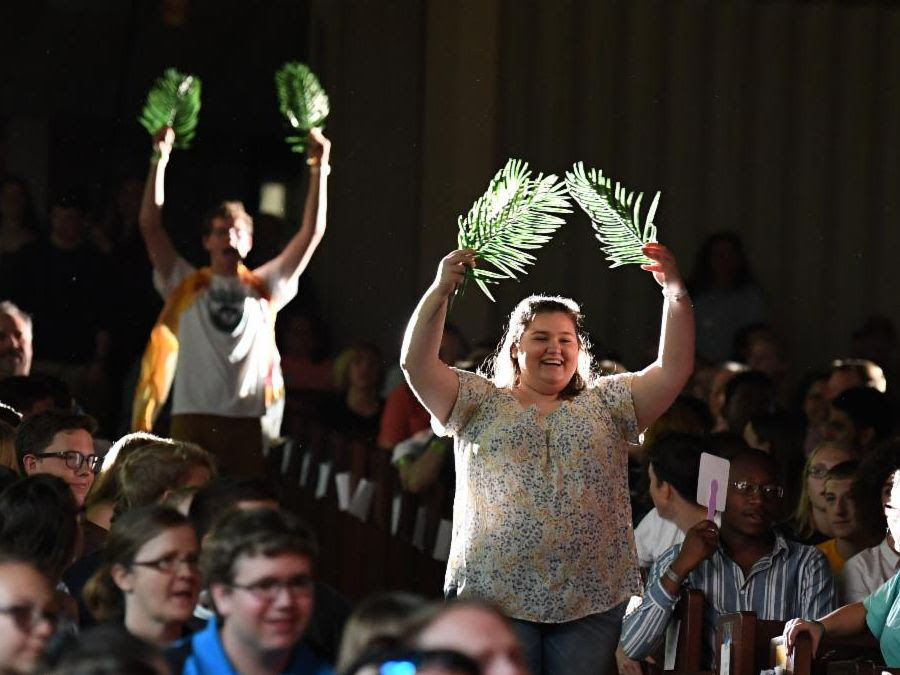
Passion / Palm Sunday begins Holy Week, a time in the church year when we remember how Christ gave his life in love for the world. As this service opens, the crowd waves palm branches, wanting to crown Jesus as king. But as the story of the passion unfolds, their shouts of praise turn to demands for his crucifixion; he receives a crown of thorns as he is handed over to be mocked and killed.
"The question is frequently asked, Why combine the passion and the palms?
First, it is in accord with historical tradition. Since at least the fourth century, the focus on the first day of Holy Week, or Great Week, has been the passion of Christ. After a palm processional, a Gospel passion narrative has been read. Western churches have kept the first day of Holy Week by concentrating on both the glory and the passion of Christ, recalling both the passion and the palms. …
Pastoral values result from combining the passion and the palms. Many people simply do not attend worship on Good Friday. The result is that, for them, there is a distortion in the story. A story that skips from Jesus’ triumphal entry into Jerusalem to Jesus’ resurrection from the dead evades the question, What happened in between? If we leap from Palm Sunday’s “Hosannas” to Easter Day’s “Hallelujahs” we overlook the pivotal event of Christ’s suffering and death on the cross. The journey to Jerusalem has the cross as its goal, and the cross needs to be kept in sight even during the triumphal entry into Jerusalem. Where the long tradition of reading the whole passion narrative on Passion/Palm Sunday is appropriated, congregations have found the value of hearing the entire passion story. …
The most important reason for combining the passion and the psalms is the relationship between the death and the resurrection of Jesus. To understand the resurrection, we must contemplate the passion of Jesus. Long, careful meditation upon the mystery of the cross must precede the glorious message of Easter.
On the one hand, an oversimplified theology of glory can under value death by implying that it is merely a stepping-stone on the path to resurrection. Therefore, in order to experience resurrection, one simply dies, and on dying will automatically ascend from the grave to glory. On the other hand, an oversimplified theology of the cross can over value death as a “work,” by implying that resurrection is merely a consequence of the passion; therefore, if one suffers and dies for the faith, one will have earned resurrection. Instead, the cross and resurrection must be held together theologically. The extent to which we understand the resurrection of Jesus will be determined by our understanding of his passion.
Thus, the palm procession with ringing Hosannas symbolically foreshadows the Hallelujahs of God’s promised future when the risen Jesus will lead his people into a new Jerusalem. Interwoven with such liturgical experiences are the stories of the passion of Christ. Thus, the eight-day week from Passion/Palm Sunday to Easter Day is framed by resurrection and death on one side, and death and resurrection on the other.
The need to affirm, as Holy Week begins, the inseparable relationship between the death and the resurrection of Jesus is precisely the reason the passion of Christ and the palms are linked together as Passion/Palm Sunday."
It may be Palm Sunday, but there’s no sign of leafy branches in Luke’s account of that day. Our worship this Sunday may resound with chorus upon chorus of “Hosanna” but in Luke’s telling of Jesus’ entry into Jerusalem, there is not a single “Hosanna” voiced from the crowd. We have to look in Matthew, Mark and John to find what we might regard as the traditional trappings of Palm Sunday. Luke’s account is the alternative version — and, in some ways, the most intriguing version. While offering neither palms nor “Hosanna,” Luke’s narrative uniquely provides us with stones.
Some of the Pharisees present implore Jesus to silence his disciples, whose praise of Jesus as he moves into Jerusalem invokes Psalm 118 and also recalls the song of the angels that accompanies his birth (Luke 2:14). In reply to the Pharisees’ request, Jesus says, “I tell you, if these were silent, even the stones would shout out” (Luke 19:40). The power of that moment, the meaning of this week, the importance of Jesus’ journey to Jerusalem cannot be denied. If his disciples don’t announce it, then the stones along the road will take up the chorus. Jesus is the one who comes in the name of the Lord. It is a bedrock truth that must be told. It cannot be ignored or silenced. If we won’t acknowledge him, praise him, acclaim him, then the stones will bear witness. The Lordship of Jesus must be proclaimed. The stones know it so.
Luke doesn’t just provide us with stones on Palm Sunday; he notes their presence all along Jesus’ journey. This season of Lent began, as it always begins, with Jesus in the wilderness, withstanding the devil’s temptations. In that forbidding and forlorn place a stone is present, a stone, the devil suggests, the famished Jesus could turn into a loaf of bread, if, of course, he was the Son of God. Jesus resists the temptation to glorify himself. The stone in the wilderness remains a stone, bearing witness to Jesus’ faithfulness to the course God has set before him.
Board of PC(USA), A Corporation approves budgets for 2023 and 2024 Looking ahead to the work of the next two years, the board of the PC(USA.), A Corporation has approved budgets for the Administrative Services Group of $19.4 million for 2023 and $19.9 million for 2024. — Leslie Scanlon
Tech watch: Pomodoro Technique In a world full of distractions, the Pomodoro Technique is one way to focus your attention on the work you’re trying to get done. — Leslie Scanlon
The long game of preaching: focusing on the basics "Preaching is an on-going conversation. Focusing on every word and rhetorical flourish isn’t sustainable when you have to write these dang things every week. And it won’t serve a congregation well." — Jonathan Saur
During Holy Week, we recall the events leading up to Jesus' death and Resurrection. This week on our social media we are sharing posts for Holy Week that include a reference to a Bible passage, a stanza from a hymn, and a prayer from the Book of Common Worship. Follow along on our posts to read our messages from Palm Sunday through Easter Sunday.
Many people spread their cloaks on the road, and others spread leafy branches that they had cut in the fields. Then those who went ahead and those who followed were shouting, !Hosanna!
Blessed is the one who comes in the name of the Lord!
Blessed is the coming kingdom of our ancestor David! Hosanna in the highest heaven!”
—Mark 11:8–10
Ride on! Ride on in majesty! In lowly pomp ride on to die; O Christ, thy triumphs now begin o'er captive death and conquered sin.
—Henry Hart Milman (Glory to God, hymn 198)
---
We praise you, O God, for your redemption of the world through Jesus Christ, who entered the holy city of Jerusalem in triumph and was proclaimed Messiah and king by those who spread garments and branches along the way. Amen.
(Reprinted by permission from the Book of Common Worship, copyright 2018, Westminster John Knox Press. All rights reserved.)
Here's the podcast of the worship service I led in the First United Presbyterian Church of Mingo Junction, Ohio on Sunday, March 28, 2021.Below is a copy of our bulletin.
Here's a copy of the order and the podcast of the worship service I led in the First United Presbyterian Church of Brilliant, Ohio on Sunday, March 28, 2021.Below was our bulletin.
Here's the message I offered during the celebration services in the First United Presbyterian Church of Brilliant, Ohio and First United Presbyterian Church of Mingo Junction, Ohio on Sunday, March 28, 2020.
Mark 11:1-11 [Contemporary English Version]
Jesus and his disciples reached Bethphage and Bethany near the Mount of Olives. When they were getting close to Jerusalem, Jesus sent two of them on ahead. He told them, “Go into the next village. As soon as you enter it, you will find a young donkey that has never been ridden. Untie the donkey and bring it here. If anyone asks why you are doing that, say, ‘The Lord needs it and will soon bring it back.’”
The disciples left and found the donkey tied near a door that faced the street. While they were untying it, some of the people standing there asked, “Why are you untying the donkey?” They told them what Jesus had said, and the people let them take it.
The disciples led the donkey to Jesus. They put some of their clothes on its back, and Jesus got on. Many people spread clothes on the road, while others went to cut branches from the fields.
In front of Jesus and behind him, people went along shouting,
“Hooray!
God bless the one
who comes
in the name of the Lord!
God bless the coming kingdom
of our ancestor David.
Hooray for God
in heaven above!”
After Jesus had gone to Jerusalem, he went into the temple and looked around at everything. But since it was already late in the day, he went back to Bethany with the twelve disciples.
Did You Ever Own a Leisure Suit?
Since we’re just one week before Easter, I think it’s time to get serious: no more elephant jokes and no more talk about a basketball tournament. I mean, Easter is nothing to laugh about, right? And so, with that in mind, this morning I have a profound, theological question for y’all. In fact, it’s one that will provide both the focus and the basic structure for this entire homily. (Now, that just a fancy word for “sermon,” but since we’re getting serious, I think it’s appropriate.) And the question, well here it is: Did you ever own a leisure suit? Of course, I recognize that’s a little too narrow, so let me broaden it out a bit: Did you ever own or know someone who owned a leisure suit? Well, did you? Now that’s the question. And I can tell you, with absolutely no fear of contradiction, I can give an emphatic “no” to the first but a big “yes” to the second.
Now just in case you’re too young to remember, right along with disco, roller skates and pet rocks, leisure suits defined the ‘70s. And they were, well, they were an acquired taste. I mean, they were made of polyester and generally they either were covered with a big, bold plaid or were in a color not found in the nature, with big lapels and pack pockets and stitching in a contrasting color. And since being unnatural was really what leisure suits were all about, under the jacket, the stylish man wore an imitation silk or satin shirt, with as many gold chains and medallions as his neck could support. And to complete the look, you really needed vinyl platform shoes. I’m telling you, it was all part of “staying alive” in the 1970s.
And you know, even though my dad never convinced me to buy one myself and trust me, he tried, leisure suits were extreme popular. I’m telling you, I think every guy, regardless of age, assumed he looked a little like John Travolta. Man, they were every where, even in church. That is until they weren’t. And right along with the leg warmers of the ‘80s and the cargo pants of the ‘90s, most leisure suits ended up at Good Will and are now only worn at Halloween parties. A sad end for a style that was “out of sight. Can you dig it?”
And even though I kind of enjoyed taking this little stroll down memory lane, there’s a reason I brought up leisure suits this morning. When we compare how they were initially received with how they were ultimately discarded, well, I think that same sort of thing occurred with the crowd according to the Evangelist Mark, especially between Jesus’s entry into Jerusalem, something that we read about a little while ago, and his appearance before Pilate. You see, in the space of less than a week, Jesus simply went out of fashion. Now that’s what happened. And because of that, for the next ten minutes or so, we’re going look at what happened with them back in the day and consider not only how it could also happen to us but how we might avoid it.
And you know, when you think about it, this shift in the crowd was both sudden and dramatic, especially when you consider where they were at the beginning. I mean, just listen to how Mark described the scene as Jesus entered Jerusalem:
The disciples led the donkey to Jesus. They put some of their clothes on its back, and Jesus got on. Many people spread clothes on the road, while others went to cut branches from the fields.
In front of Jesus and behind him, people went along shouting,
“Hooray!
God bless the one
who comes
in the name of the Lord!
God bless the coming kingdom
of our ancestor David.
Hooray for God
in heaven above!” [Mark 11:7-10, CEV]
Now, that’s how Jesus was received. And as I read it, it seems as though the crowd assumed that Jesus was going to do exactly what they expected a great Jewish leader to do: namely, to kick the Romans out and to restore the kingdom of David, something that Jesus had sort of alluded to when he talked about the Kingdom of God. In other words, right here, on the road leading to Jerusalem, God’s rule would stop being just a mustard seed. Instead it would start to grow. Now, that’s what I believe they thought when they saw Jesus entering the Holy City.
But I’ll tell you, based on what happened in about five days, that must have changed. Now maybe it was because Jesus’s focus and his message weren’t exactly the same as they’d come to expect. For example, instead of performing miracles and passing out free food, Jesus seemed more focused on what he needed to do, namely, to suffer and to die. And instead of talking about how the kingdom, the rule of God was going to grow and provide shelter and protection, now the Kingdom was a reality that rich people couldn’t enter and that was governed by a person’s willingness to love God and to love neighbor. You see, instead of being the kind of leader who would drain the swamp and make Judah great again, frankly, Jesus had become sort of a downer and a distinct disappointment. Now, maybe that happened; we can’t be sure because Mark didn’t tell us about their motivation. But this we do know. After being betrayed by Judas and after being denied by Peter and after watching the rest of this twelve closest followers run away, this was what happened:
During Passover, Pilate always freed one prisoner chosen by the people. And at that time there was a prisoner named Barabbas. He and some others had been arrested for murder during a riot. The crowd now came and asked Pilate to set a prisoner free, just as he usually did.
Pilate asked them, “Do you want me to free the king of the Jews?” Pilate knew that the chief priests had brought Jesus to him because they were jealous.
But the chief priests told the crowd to ask Pilate to free Barabbas.
Then Pilate asked the crowd, “What do you want me to do with this man you say is the king of the Jews?”
They yelled, “Nail him to a cross!”
Pilate asked, “But what crime has he done?”
“Nail him to a cross!” they yelled even louder.
Pilate wanted to please the crowd. So he set Barabbas free. Then he ordered his soldiers to beat Jesus with a whip and nail him to a cross. [Mark 15:6-15, CEV]
You see, that’s what the Evangelist Mark wrote: the same crowd that greeted Jesus with “hoorays” and blessings in less than a week later was telling the Roman governor, a guy they really hated, to nail Jesus to a cross, in other words, to crucify him. Now that’s what happened.
And I’ll tell you, I think this should really be a cautionary tale for us right here and right now. I mean, let’s get real, we all come to Jesus with a whole bunch of assumptions and expectations and most of them really aren’t all that different from those carried around by that crowd in Mark. For example, there’s certainly a big part of me that assumes that Jesus came to make life better for those who follow him. My gosh, at the very least, we should be a little healthier and a little wealthier and frankly, a whole lot happier than those who don’t follow, am I right? And I really want to believe that he’s about to bring in the rule of God and when he does, all those folks whom I don’t like or agree with, man, they are going to get exactly what I think they deserve, while everyone who’s like me, well, we’ll also get exactly what I think we deserve, which just happens to be what we also desire. Now, I don’t know about y’all, but that’s the Jesus I want to follow. And that’s the one who just might motivate me to lay a couple of my Harris Tweed jackets on a road and to shout about how great my life, excuse me, our lives are going to become.
And even though all that sounds great, how do you think I’m going to handle it not happening? In other words, what would you expect me do when, instead of getting wealthier, I get laid off. And instead of getting healthier, I get a less than glowing report from my doctor. And instead of getting happier, all those old problems and pains are still there, and I’m still feeling all the same fears and frustrations that I felt before. And if that’s not bad enough, instead of the stinkers and the liars and the cheats finally reaping what they’ve sown, instead of that happening,like that great American writer, F. Scott Fitzgerald said, “The rich get richer and the poor get - children.” Well, ain’t we got fun. Now, when all those things happen, and I think everybody here knows that they have, they do and they will, how do you think I’m going to react? I’ll tell you, crying for the crucifixion of that kind of Christ so that he can be replaced with one who better satisfies my assumptions and meets my expectations, man, that doesn’t seem all that far-fetched, now does it?
But before we join that crowd in Pilate’s court, let’s pause for just a minute and think about it a little bit. And I’ll tell you why. Even though doing something like that may be tempting and given the values of the world around us, actually make a lot of sense, I don’t think anyone here this morning wants to nail Jesus to the cross again. And for that reason, maybe we should put aside our assumptions and actually listen to what Jesus had to say, you know, like when he taught, “If any of you want to be my followers, you must forget about yourself. You must take up your cross and follow me. If you want to save your life, you will destroy it. But if you give up your life for me and for the good news, you will save it.” [Mark 8:34b-35, CEV] Or like when he said, “The most important [commandment] says: ‘People of Israel, you have only one Lord and God. You must love him with all your heart, soul, mind, and strength.’ The second most important commandment says: ‘Love others as much as you love yourself.’ No other commandment is more important than these.” [Mark 12:29b-31, CEV] Of like when he told his disciples, “No one knows the day or the time. The angels in heaven don’t know, and the Son himself doesn’t know. Only the Father knows. So watch out and be ready! You don’t know when the time will come.” [Mark 13:32-33, CEV] You see, instead of assuming, maybe we should be listening. And right along with listening, maybe we should put our expectations on a back burner and accept that Jesus knew exactly what he came to do and did it. As he said to his disciples before they entered the city, “We are now on our way to Jerusalem where the Son of Man will be handed over to the chief priests and the teachers of the Law of Moses. They will sentence him to death and hand him over to foreigners, who will make fun of him and spit on him. They will beat him and kill him. But three days later he will rise to life.” [Mark 10:33-34, CEV] You see, if there’s no cross, there’s no empty tomb. And brothers and sisters, if there’s no empty tomb, we have no hope. But that’s why Jesus came, and when we accept that, instead of joining that crowd before Pilate, calling for his crucifixion, we just might find ourselves with that soldier at the cross. As Mark wrote, “A Roman army officer was standing in front of Jesus. When the officer saw how Jesus died, he said, ‘This man really was the Son of God!’” [Mark 15:39, CEV]
Now, like I said a little while ago, I never owned a leisure suit, but I’ve got to admit, that didn’t stop me from joining the fashion parade that was the ‘70s. You see, while in college, I worked at Anderson-Little right in the Military Circle Mall, and I proudly sold the best polyester out of Fall River, Massachusetts. And since I got a discount, that shaped my wardrobe for about a decade. In fact, when I was attending seminary in the mid-‘80s, one day a woman I was dating looked in my closet and said, “Ed, if there was a fire in your apartment, your clothes wouldn’t burn; they’d melt.” Of course, by then, the world had moved and leisure suits had been replaced by preppy blazers and polyester by natural fibers. Styles change.
And I’ll tell you, as shown by the crowd we looked at in Mark, so can people. You see, if we let our assumptions and expectations get in the way, it’s really not hard to understand how sincere folks can greet Jesus with “hosannas” and five days later call for his crucifixion. And for that very reason, I think it’s important for us to shove what we assume and what we expect to side so that we can really listen to what Jesus taught and accept what he came to do. And I’ll tell you, if we do that, then “Did You Ever Own a Leisure Suit?” just might be the only irrelevant question we’ll face as we move toward Easter.