Showing posts with label Ken Rummer. Show all posts

Saturday, December 5, 2020

Sightings - Looking for signs of hope: Maple buds and brimming cups

Maple buds as signs of hope

Photo Credit: K. Rummer 2020

by Ken Rummer

Look for signs of hope. The teachers of resilience offer this wisdom to the storm-tossed, the overwhelmed, the anxious. You may be way ahead of me here, but it’s advice I’m trying to take.

A couple of weeks ago—it was on a Monday—I was staring out the window during computer church at home. Has anyone else discovered that with online, prerecorded services, Sunday is no longer a use-it-or-lose-it worship opportunity?

Through the glass I saw the upper branches of our young maple tree, showing dark against a winter-gray sky. The signature red leaves had fallen, leaving the branches bare, except for a couple of curled and crusty hangers-on.

Then I noticed buds on every branch. 

In those buds, the makings of next year’s leaves and tree flowers, tightly packed in tough casings, were hibernating before my eyes like bears in caves, unfazed by freezing temps and the forecast arrival of the third measurable snow of the season.

Unfazed is not the word I’d choose for myself these days. 

I’m worried about the trajectory of the virus. Physical separation weighs on my heart. And every odd cough makes me wonder. 

I hear the daily count of ICU beds in use. Church bells toll the COVID dead. And, though a vaccine is in view, pandemic end is not yet in sight.

I am definitely fazed.

But buds on bare branches—tiny vaults, crammed with good things to come, waiting for the spring day set on their time locks to arrive—those buds are a sign of hope for me.

Today, turning my attention from the maple to the Bible on the desk, I follow a nudge of memory to a verse from Romans, where the apostle asks God to fill readers with “joy and peace in believing” so that they may “abound in hope.” (Romans 15:13 NRSV). 

Now abound is not a word we use everyday. To put it into a picture, I might explain it this way: abound is a glass being filled by a careless server. When the rising liquid reaches the rim, the waiter, perhaps distracted, doesn’t stop pouring, and the glass overflows, to the astonishment of the whole table. 

Imagine having so much hope that it would fill us completely and overflow, splashing on those around us. But that is the gist of the prayer in Romans. And the possibility that God is still answering that prayer, pouring hope generously into our open glasses—well, that is another sign of hope for me.

Tonight I’m seeing something new outside our maple-view window. It’s a star, our first outside decoration of the season. Wrapped with space foil and festooned with LED bulbs, it hangs, not from the highest bough, but from the arch above the front porch. 

To my eye, the light of that star is a twinkling testimony to hope. The budded hope that waits concealed in plain sight. The poured hope that fills and overflows.


Ken Rummer writer

Ken Rummer, a retired Presbyterian pastor, writes about life and faith from the middle of Iowa by the High Trestle Trail. Previous posts are available at: http://presbyterianmission.org/today/author/krummer

Friday, October 2, 2020

Sightings - What’s getting me through these days

Three tested tactics

by Ken Rummer

I’m a small child in a crib, struggling to breathe in the night, clogged up with what will turn out to be allergies and asthma. My crying rouses my parents who take turns responding. 

Being picked up and held vertically helps. I can breathe better and settle a bit. 

Back in the crib, I’m feeling the congestion return, cutting off the air. Again I’m crying. Again a parent comes in.

After several trips, my father says they can’t keep doing this. He returns me to the crib, says a prayer putting me in God hands, and goes back to bed. My crying does not bring another parent visit.   

The memory of that night came back to me recently when I made of list of difficult times in my life. What’s getting you through these pandemic days was the question, and I thought I’d see what had helped get me through hard days before.

Out of that inventory, I identified three tactics that have helped me in challenging times, and more than once. You’re welcome to borrow any or all. 

1. Resync With Music

In high school I played violin in a baroque musical ensemble—strings, recorders, harpsichord, lacy neckwear, knee britches. I noticed that after two hours of rehearsing Bach and Vivaldi, my unfinished homework had quit shouting at me. Somehow the ordered notes had restored my inner order, and I drove home feeling more calm.

Presently I’m playing beginner piano most days. When my fingers are on the keys, I’m not thinking about pandemics and worst-case scenarios and push-my-buttons posts on social media. And I’m feeling less anxious.

Cue up your favorite playlist. Take up a new instrument. Stream a concert by your favorite group. You may discover that your scattered fragments are finding their places. Engaging with music can do that.

2. Refocus With Projects

Another tested tactic for difficult days is taking on a project. An out-of-state move in the middle of high school shook my foundations. But building a two-person sailboat with my dad that year filled a lot of empty places. Even when the waves were sloshing into our open pontoons.

Currently, my wife and I are sorting pictures and adding captions for a photo book. The oldest grandchild just turned ten, so we are attempting a ten-year book featuring our four grandchildren.

Maybe for you it’s quilting, or turning all the flour in your pantry into baked goods, or applying the principles of tidying to your closet. Or painting your family room, or laying pavers for a new patio, or getting that old mower running that hasn’t started in two years.

Tackling a project paints a goal line out in the future, but not too far. Measured in days, a project takes the mind off uncertain months and years. And you can mark your progress.

3. Rebalance With Faith

Reaching out to God is another of my tested tactics for getting through a difficult season. In the uncertainties of the present pandemic, an affirmation passed down through my faith tradition points to my deepest deep-down hope: in life and in death we belong to God. 

I first leaned on this and found it strong, as that small child struggling to breathe in the night. My parents had done all they knew how to do and they put me in God’s hands. Scared and exhausted, I finally did the same.

Not knowing if I would wake up again, I reached out to the God in whom my parents trusted, and went to sleep. 

Whatever your religious identity and commitment, you may find, digging down into your beliefs, something or someone you can trust come what may. Stand there, on that bedrock of your faith. It’s a way to regain your balance, even in these days.


Ken Rummer writer

Ken Rummer, Teaching Elder PCUSA, Honorably Retired

Ken Rummer writes about life and faith from the middle of Iowa by the High Trestle Trail. Previous posts are available at http://presbyterianmission.org/today/author/krummer
Saturday, August 8, 2020

Sightings - The pumpkin and the bee

An observation

by Ken Rummer
The pumpkin is bigger than a softball now,  in dark green with a few warty bumps. It’s something of an accident.
Last fall, when our porch pumpkin sagged into mushy flatness, I carried it out back on a shovel, and deposited it, without eulogy or ceremony, behind the garage. Mowing near the place this spring, I was surprised to find four or five leafy stems sprouting from a pile of pumpkin seeds.
Note: Credit for the pumpkin picture goes to Presbyterians Today editor, Donna Frischknecht Jackson. Seeing this photo in her Accidental Country Pastor post (FB@DonnaFrischknecht/AccidentalCountryPastor), I flashed back  to a story I wrote for the Adams County Free Press in 1997. Here is that story, tweaked, trimmed and fully refurbished. Enjoy. — Ken Rummer 
I figured I should pull out all but one to get a stronger vine, but I didnʼt have the heart. So they all kept growing. Across the yard. Out toward the alley. One even grew up into the forsythia bush, clear to the top.
Large green leaves and striking orange flowers grace the vines, and on one I recently discovered a growing pumpkin, the green one I mentioned earlier. I’m hoping it makes it all the way to big and orange.
Of course, a lot can happen between now and frost, some of it bad for pumpkins. But it would be nice to see the offspring of last yearʼs porch pumpkin promoted to this year’s jack o’ lantern.
I keep looking for other pumpkins-in-progress. Turning back the leaves with my foot. Checking the places the flowers have been. So far, I havenʼt seen any.
I did notice, in one of the large Victrola-horn flowers, a bee. It was busily doing its bee thing, climbing around inside the flower, slurping up flower juice, and buzzing in an important-business-being-done-here-leave-me-alone sort of way.
I imagine if you were to ask the bee, “What are you doing?” the bee would say, ”Making honey.” At the top of that beeʼs to-do list you would most likely find, “Make Honey,” and at the end of the day, the bee could check it off. “Made honey.”
But for a few minutes in our impromptu patch behind the garage, that bee was also making pumpkins. Leg hairs loaded with pollen, dropping a little off at each flower along the way, that bee was making pumpkins.
Now I donʼt want to get into an argument about which is the more important work, making honey or making pumpkins. That depends to a certain extent on whether you have a hankering at the time for pie or for biscuits. But I am thinking about that bee, working hard to make honey and along the way making pumpkins, too.
I wonder what important things God might be doing along the way while weʼre busy doing something else. I’m thinking about the interruptions, the chance encounters, the strangers, the people who watch from a distance, the folk who are around us all the time.
You and I, in Godʼs scheme of things, may be doing some important things in this world while weʼre busy with what we think of as our main work. And we may not even know weʼre doing them.
Itʼs a grace and a wonder, the way I see it. Like the pumpkin and the bee.
Ken Rummer writer
Ken Rummer, Teaching Elder PCUSA, Honorably Retired
Ken Rummer, a retired Presbyterian pastor, writes about life and faith from the middle of Iowa by the High Trestle Trail. His other posts are available at http://presbyterianmission.org/today/author/krummer

Friday, July 3, 2020

Sightings - When words collide

Bumping through the Lord’s Prayer

by Ken Rummer 
backlit sprinkler spray as picture of Lord's PrayerIn my pastoring days, I often invited the mourners at the graveside to join in praying the Lord’s Prayer. I suppose it was a vestige of Christendom culture, the assumption that most everyone there would know the prayer by heart, but in our rural town most did.
The recitation of the prayer gave those gathered a chance to participate, to place a verbal stone on the grave marker. Their voices sounded united and strong and full of faith, right up to the line that begins, “Forgive us…”.
You see, we tended to draw a mixed crowd for funerals. The desire to honor the dead and to support the family often overrode the taboo around entering a different church or hearing a different priest or minister. 
So when we prayed the Lord’s Prayer at the graveside and came to the petition about forgiveness, the Disciples would join the Presbyterians on debts, but the Methodists, the Lutherans, and the Catholics would veer off into trespasses, which was two syllables longer and threw off the timing, a difficulty only compounded by the variations in the next phrase that starts, “As we forgive…”.
It always felt awkward.
I tried cuing the words at the beginning. I tried teaching confirmands an ecumenical common-text version. I tried speaking the word debts more softly and giving extra time for trespasses.
Still awkward.
It used to bug me. Why can’t Christians pray the same Lord’s Prayer? 
But then I made a pilgrimage to Geneva. (Not Wisconsin. Switzerland.)
Reformed churches predominated in the city of Calvin, but a few other brands had a presence. I attended worship at one of those, a Lutheran church, if memory serves.
The majority of the liturgy was in English. Though not the first language for many attending, in a city of global commerce and world diplomacy, it was a language most had in common.
When we came to the Lord’s Prayer, the pastor invited us to speak the prayer in the language we first learned it. And we did. In Norwegian and German and Portuguese and Spanish and Korean and Arabic and Swahili. This was no minor scuffle between Methodists and Presbyterians over trespasses and debts. This was a major linguistic mashup.
And it was beautiful. Holy and unexpected and beautiful. 
Like bird song and frog chorus overdubbed with the music of cicadas just emerging after 17 years underground. Like “Halleluja” and “Thank you, Jesus” stirred into glossolalia praise. Like a choir drawn from every people, tongue, and nation.
Goosebumps. 
The Presence present.
I decided that if God could bless the Our Father prayed in all those languages at once, I could quit stressing about traditional differences in the wording. 
So now I like to invite folks to pray the prayer using the words they know best.
It doesn’t tend to be tidy. But it does draw us together and take us back to Jesus and aim our hearts toward God.
And the word bumps? I’m trusting God to sort them out.
Ken Rummer writer
Ken Rummer, Teaching Elder PCUSA, Honorably Retired
Ken Rummer writes about life and faith from the middle of Iowa by the High Trestle Trail. Previous posts are available at http://presbyterianmission.org/today/author/krummer 

Friday, June 5, 2020

Sightings - Listening to the pines

Tree wisdom for pandemic life

by Ken Rummer
Scotch pine set off against partly cloudy skyFrom my favorite pew at church — yes, even retired ministers tend to sit in the same place on Sunday — from that special spot I can look up and out through the clear windows around the cross and see the tops of pine trees.
With in-person worship on extended hold as a virus precaution, I see the pines in memory now, their needles rippling in irregular waves like monster fur in a Pixar movie. I relax a bit. It feels familiar, like bumping into someone I know.
They are Scots pines, if I have the identification right: small cones, crooked branches, orange bark on the upper limbs.
Some object to the common name Scots or Scotch for these trees because, although they are found in Scotland, they are also native to the northern reaches of Europe and Asia. Their scientific name, Pinus sylvestris (wild pine or pine of the forest), offers a geographically neutral form of address.
I like the look of the pines against the dark clouds of a summer storm. Powder-sugared with snow, they complement the slate-gray backdrop of mid-winter. And seeing their needles set off against a blue, blue sky by the slant sun of a spring morning? Quietly astonishing.
They are doomed, of course—those trees. A plague of pine wilt hangs over our state. The disease process is complicated, involving a nematode hitchhiking on a sawyer beetle, but once a tree is infected, it can go from green needles to brown, from life to death, in a matter of weeks.
Pine wilt is so widespread and fatal in these parts that Iowa State University lists Scots pine as “no longer recommended for long term planting.” The ones we see now are likely going to die.
Truth be told, so are we.
So I’m enjoying the trees while I can. The last time I saw them from my pew, they were full of spring, gripping flower stalks at branch ends like acolytes bearing candles.
But brown needles here and there concerned me. Is it the normal shedding of the oldest needles, or something more sinister? I’m remembering the pines in the next yard that looked to be of the same vintage. Fatally infected, they have already gone the way of the chain saw. My trees could be next.
How then to live in the shadow of death? By going high risk, riding rodeo bulls and jumping out of airplanes? By being extra careful, hiding out in a room filled with pillows? By trying not to think about it, clicking the channel and thumbing the phone?
Approaches differ, but the question remains: how best to live when stalked by death?
I ask the pines, but I can’t make out their reply. Perhaps I require a certified translator, or the ears of a child.
The pines just keep reaching toward the sun, and dancing with the wind, and welcoming the birds that stop to perch and nest and sing.
But maybe that’s an answer after all.
Ken Rummer writer
Ken Rummer, a retired Presbyterian pastor, writes about life and faith from the middle of Iowa by the High Trestle Trail. Additional posts may be found at http://presbyterianmission.org/today/author/krummer

Friday, April 3, 2020

Sightings - The goldfinch and the virus

With a word and a prayer

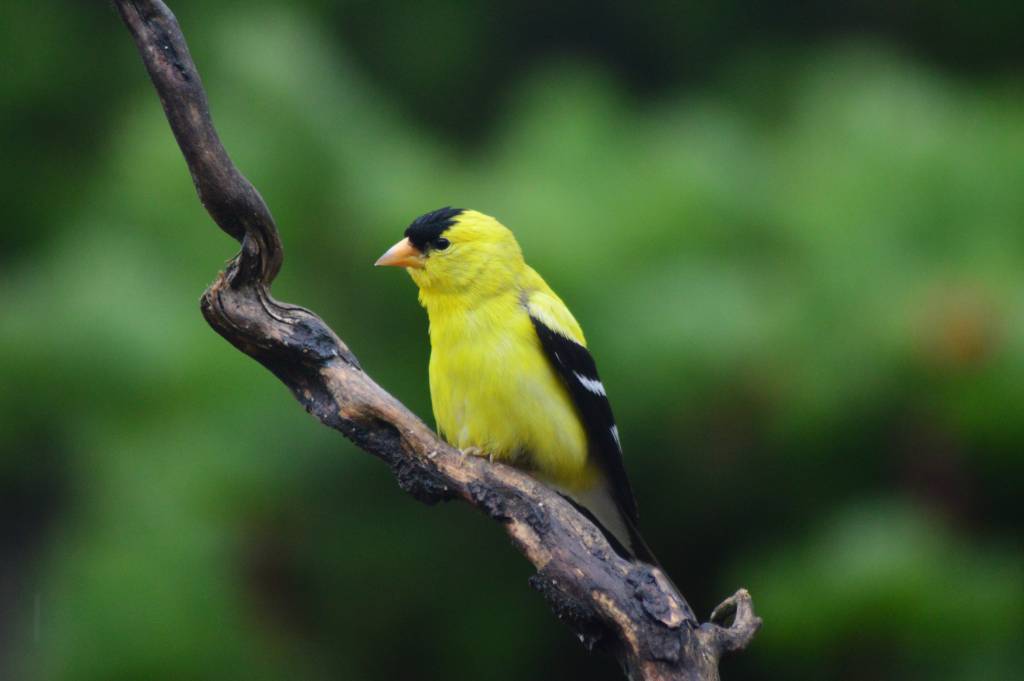
gold finch for blogWalking the trail yesterday, I caught a flash of yellow in the wild plum stems—a goldfinch, the first I’ve seen this season. After last week’s snow, I took it as a welcome sign of spring.

Red-winged black birds perched along the path, spaced out like sentries and trilling their “Who goes there?” from branch and prairie stalk.

I missed the laughter of the creek. A beaver dam once gave the waters their splash, but it has disappeared along with its flat-tailed engineers. Voiceless now, the stream seemed eerie in its silence.

Eerie, too, was the thought that invisible specks neither living nor dead, zombie bits of genetic code, could even then be rafting from person to person on tiny drops of spit.

A scary, new-to-humans virus is loose in the world. Fever? Cough? Loss of smell? Has COVID-19 reached me yet?

As of now we have no immunity, no vaccine, no cure. Only the hope of slowing the onslaught with oft-washed hands and physical distance.

While I’ve been staying home as recommended except for permitted walk-abouts (while staying at least six feet away from anyone we might encounter), I’ve been reading some pages by Reformation leader Martin Luther.

Five hundred years ago, some cities in what is today Germany were experiencing a return of the bubonic plague. This was the same disease that had killed a third of the population of Europe in the 1300s, an estimated 50 million.

In 1527, a few months into an outbreak of plague in his city of Wittenberg, Luther wrote a pamphlet titled: Whether One May Flee From A Deadly Plague. 

Steering a middle course between what he saw as the cowardly abandonment of neighbors in need on the one side and the taking of undo risks in the name of faith on the other, Luther commended to his readers his own approach to the plague.

…I shall ask God mercifully to protect us. Then I shall fumigate, help purify the air, administer medicine and take it. I shall avoid places and persons where my presence is not needed in order not to become contaminated and thus perchance infect and pollute others, and so cause their deaths as a result of my negligence.

To my anxious ear, this sounds like a word for our present moment. Look to God. Stand ready to help our neighbor. Do what we can to avoid infection. And try not to carry it to others.

As we step into that challenge, let me offer a prayer for our journey, one set down around the year 400 by a Christian church leader who was living through the fall of the Roman Empire, Augustine of Hippo.

Grant us, dear God, 
in all our duties your help; 
in all our uncertainties your guidance; 
in all our dangers your protection; 
and in all our sorrows your peace.
Amen.
Ken Rummer writer


Ken Rummer writer
Ken Rummer, a retired Presbyterian pastor, writes about faith and life from the middle of Iowa near the High Trestle Trail. His previous posts are available at http://presbyterianmission.org/today/author/krummer
Luther quotation from Martin Luther’s Basic Theological Writings, 1989, Augsburg Fortress. Prayer from Book of Common Worship, 2018, Westminster John Knox Press.

Saturday, March 7, 2020

Sightings - Poking around in the ashes

A reflection for Lent

by Ken Rummer   
ashes, charcoal, fireLast year’s palm branches are burning down to ashes as I write. Tonight we will receive a smudge of those ashes on our foreheads as we repent and remember and head into the wilderness with Jesus.
Growing up, I didn’t have much experience with Lenten ashes. The ashes of my acquaintance followed the burning of charcoal in the barbecue grill. 
I remember the will-they-or-won’t-they uncertainty around getting the briquets to light. My family transitioned from lighter fluid to an electrified loop of rod. Then we switched to the metal chimney that ran on wads of newspaper. 
Whatever the method, the goal was the same: white briquets glowing red, spread evenly beneath the metal rack. Then the meat went on, usually hamburgers, followed by more uncertainty around timing the flip and getting to doneness.
Finished burgers met up with buns and cheese and ketchup and sweet pickle relish. And we topped off our plates with potato salad and orange Jello mixed with shredded carrots and pineapple. Seconds, anyone?
My favorite part came after the meal: marshmallow time. But did enough fire remain to toast them?
By then the charcoal had burned down to a lumpy layer of pale gray. I found that if you stirred around in the ashes with a stick, you could often find bits of charcoal that still glowed red, live coals hidden under the ashes. A little gathering of them together, a few (or more) puffs of air, and you had the makings of a second fire, one just right for roasting marshmallows. 
I liked mine golden brown all over, but I learned that  preferences vary, ranging from “if it’s not in flames it’s not done yet” to “why bother with a fire when they taste so good right out of the bag.”
As I make a sudden and unsignaled jump from the patio to the pew, I wonder about the ashes I’ve noticed on some of my church visits.
Back in the day,  the congregation was on the rise. So many families came they built on a classroom wing. And on Easter Sunday it was standing room only.  But years passed and times changed. Now some of the classrooms sit unused, and a good turnout leaves more places empty than filled.
Isaiah 6 offers a hopeful vision.  A seraph, one of the heavenly beings, tongs one live coal from the altar. Just one, but it’s enough to launch a prophet.
Poking around in the ashes of your congregation may turn up more live coals than that. You may well be one of them! And from those still-burning embers, gathered to receive the Spirit’s blowing, a second fire may flare, the kind that can transform a mess of marshmallows into a taste of heaven.
Ken Rummer writer
Ken Rummer, a retired Presbyterian pastor, writes about life and faith from the middle of Iowa by the High Trestle Trail. Previous posts can be found at http://presbyterian mission.org/today/author/krummer

Saturday, February 8, 2020

Sightings - Singing Hallelujah

HallelujahEven when you don’t feel like it

by Ken Rummer 
The hurting and disappointed pieces of my heart have found a ballad they can sing in Leonard Cohen’s “Hallelujah.” While I’ve been working on the song in choir practice, the song has been working on me.
Out of eighty-some verses he had written, Cohen picked four for his first recording of the song in 1984. They start with King David writing music, “the baffled king composing Hallelujah.” The second verse references David and Bathsheba with a nod to Sampson and Delilah. 
The third mentions using the name in vain and ends with a Brooklyn “what’s it to ya?” And the last verse speaks of death, the writer standing before the Lord of Song “with nothing on my tongue but Hallelujah.”
The arrangement our choir is singing omits the second verse. It might be to keep the anthem from running too long.
After each verse, the refrain consists of a single word sung four times, the word Hallelujah. 
Snagged in my wondering is a line from the third verse that begins “a blaze of light in every word.” 
The Jerusalem Talmud, one of the holy books of Judaism, remembers Rabbi Shimon ben Lakish saying that when God wrote down the Torah before giving it to Moses, God wrote with black fire on white fire (Talmud Yerushalmi, Shekalim 6:1, f. 25b).
Responding to criticism that he is taking God’s name in vain, Cohen writes “a blaze of light in every word, it doesn’t matter what you heard, the holy or the broken Hallelujah.” He believes that even the broken Hallelujahs still carry God’s fire.
I find hope in that. Because sometimes a broken Hallelujah is all I can manage to sing.
Hallelujah comes from the Hebrew language. “Hallelu” is a command to praise addressed to you and you and you. The “jah” at the end is a short version of the personal name of God, the one revealed to Moses at the burning bush. So Hallelujah packs a lot into a single word. “All you all, praise the God revealed to Moses!”
Hallelujah shows up frequently in the Book of Psalms. In Psalms 146-150, for example, it is featured at both the beginning and the end of each psalm, hiding under the translation “Praise the Lord” (NRSV).
In the Christian New Testament, Hallelujah appears in the Book of Revelation, no longer as a summons to praise, but now as an expression of praise. There we hear a great multitude in heaven crying out in worship, “Hallelujah! for the Lord our God the Almighty reigns” (Rev. 19.6 NRSV).
George F. Handel set that verse to music in his “Hallelujah Chorus.” Handel’s composition makes Hallelujah a shout of victory, a heavenly fight song following God’s big win.
Cohen’s music, by contrast, fills the word with longing. With a haunting and even broken Hallelujah, he sings his life to God. 
Though Leonard Cohen died in 2016, his “Hallelujah” lives on, inviting us to sing our lives. Even the hurting and disappointed parts.
Ken Rummer writer
Ken Rummer writes about life and faith from the middle of Iowa by the High Trestle Trail. His previous posts are available at http://presbyterianmission.org/today/author/krummer

The PC(USA) Store - You still have time to save on the Glory to God Hymnal!

Pew editions are only $20 through December 31, 2026! View this email in your browser You can still save 20% on pew editions of the Glory to ...