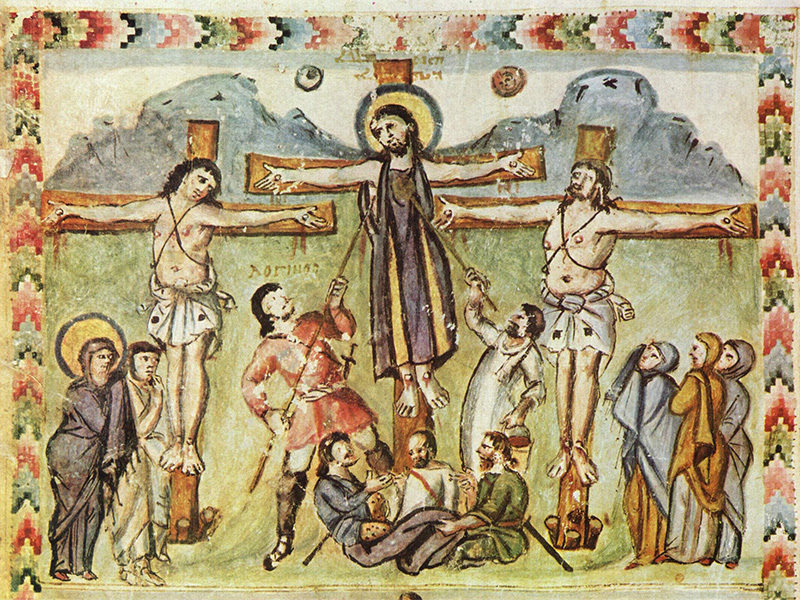
Living the Christian life involves approaching God through prayer, praise and worship. On this site, we can find different ways people have and can enter into his presence.
Good Friday is the day we remember Jesus’ crucifixion. The hours of noon to 3 p.m. are particularly significant as these commemorate the time Jesus hung on the cross. It is an especially important time to pray for the church and the world for whom Christ gave his life.
Good Friday morning in Jerusalem, May 2022. Walking the Via Dolorosa. Photo Credit: Maddi Froiland, ELCJHL.
Passion and Paradox: An excerpt from the Companion to the Book of Common Worship
(Geneva Press, 2003, 113-116, 131-132)
The Good Friday service is a penitential service, yet it is also a celebration of the good news of the cross. So, retain the paradox of the day in the form, mood, and texts of the service. Good Friday is a day in which to allow for numerous contemplative moments, and to permit the power of silence to speak for itself.
The passion narrative according to John is read on Good Friday, because at the heart of John’s passion narrative is the good news of the cross — the victory of the cross. Thus, John’s emphasis on crucifixion and glory corresponds to the tension and ambiguity of the day.
The Good Friday service is intentionally in concert with the broad ecumenical tradition, and representative of many ecumenical aspects. It, therefore, reflects a commonality with many strands of Christian tradition.
The proclamation of the readings for the day may replace the sermon, or a brief sermon may precede, interweave, or succeed the readings for the day. Those who plan the liturgy may consider letting the gospel speak through the power of silence, or through an appropriate liturgical dance or offering of music, which may help deepen reflection on the cross for all worshipers.
A fitting response to the hearing of the passion of Christ is intercession in the form of bidding prayers for the whole family of God and the afflictions of the world [the Solemn Intercession]. This is an important element of the Good Friday tradition. Such bidding prayers are signs of our joining in Christ’s priestly ministry of fully extending his arms in order to embrace all God’s people (that is, his posture on the cross).
The Solemn Reproaches [of the Cross] are an ancient text of Western Christendom associated with Good Friday. They need to bread slowly and clearly. The Solemn Reproaches take the place of confession in this service, so no Confession of Sin and Declaration of Forgiveness are included in the service.
The Service for Good Friday draws people into the story of the passion of Christ. It is composed of contrasting actions and moods of the solemn reading of the passion of Christ and, yet, a hopeful look toward the resurrection. … [I]t is most dramatic and meaningful when all depart in silence. The service continues with the Great Vigil of Easter on Saturday, or an Easter Day service.
See, my servant shall prosper; he shall be exalted and lifted up, and shall be very high. Just as there were many who were astonished at him—so marred was his appearance, beyond human semblance, and his form beyond that of mortals— so he shall startle many nations; kings shall shut their mouths because of him; for that which had not been told them they shall see, and that which they had not heard they shall contemplate.
Who has believed what we have heard? And to whom has the arm of the Lord been revealed? For he grew up before him like a young plant, and like a root out of dry ground; he had no form or majesty that we should look at him, nothing in his appearance that we should desire him. He was despised and rejected by others; a man of suffering and acquainted with infirmity; and as one from whom others hide their faces he was despised, and we held him of no account.
Surely he has borne our infirmities and carried our diseases; yet we accounted him stricken, struck down by God, and afflicted. But he was wounded for our transgressions, crushed for our iniquities; upon him was the punishment that made us whole, and by his bruises we are healed. All we like sheep have gone astray; we have all turned to our own way, and the Lord has laid on him the iniquity of us all. He was oppressed, and he was afflicted, yet he did not open his mouth; like a lamb that is led to the slaughter, and like a sheep that before its shearers is silent, so he did not open his mouth. By a perversion of justice he was taken away. Who could have imagined his future? For he was cut off from the land of the living, stricken for the transgression of my people. They made his grave with the wicked and his tomb with the rich, although he had done no violence, and there was no deceit in his mouth.
Yet it was the will of the Lord to crush him with pain. When you make his life an offering for sin, he shall see his offspring, and shall prolong his days; through him the will of the Lord shall prosper. Out of his anguish he shall see light; he shall find satisfaction through his knowledge. The righteous one, my servant, shall make many righteous, and he shall bear their iniquities. Therefore I will allot him a portion with the great, and he shall divide the spoil with the strong; because he poured out himself to death, and was numbered with the transgressors; yet he bore the sin of many, and made intercession for the transgressors.
Psalm 22
My God, my God, why have you forsaken me? Why are you so far from helping me, from the words of my groaning?
O my God, I cry by day, but you do not answer; and by night, but find no rest.
Yet you are holy, enthroned on the praises of Israel.
In you our ancestors trusted; they trusted, and you delivered them.
To you they cried, and were saved; in you they trusted, and were not put to shame.
But I am a worm, and not human; scorned by others, and despised by the people.
All who see me mock at me; they make mouths at me, they shake their heads;
“Commit your cause to the Lord; let him deliver— let him rescue the one in whom he delights!”
Yet it was you who took me from the womb; you kept me safe on my mother’s breast.
On you I was cast from my birth, and since my mother bore me you have been my God.
Do not be far from me, for trouble is near and there is no one to help.
Many bulls encircle me, strong bulls of Bashan surround me;
they open wide their mouths at me, like a ravening and roaring lion.
I am poured out like water, and all my bones are out of joint; my heart is like wax; it is melted within my breast;
my mouth is dried up like a potsherd, and my tongue sticks to my jaws; you lay me in the dust of death.
For dogs are all around me; a company of evildoers encircles me. My hands and feet have shriveled;
I can count all my bones. They stare and gloat over me;
they divide my clothes among themselves, and for my clothing they cast lots.
But you, O Lord, do not be far away! O my help, come quickly to my aid!
Deliver my soul from the sword, my life from the power of the dog!
Save me from the mouth of the lion! From the horns of the wild oxen you have rescued me.
I will tell of your name to my brothers and sisters; in the midst of the congregation I will praise you:
You who fear the Lord, praise him! All you offspring of Jacob, glorify him; stand in awe of him, all you offspring of Israel!
For he did not despise or abhor the affliction of the afflicted; he did not hide his face from me, but heard when I cried to him.
From you comes my praise in the great congregation; my vows I will pay before those who fear him.
The poor shall eat and be satisfied; those who seek him shall praise the Lord. May your hearts live forever!
All the ends of the earth shall remember and turn to the Lord; and all the families of the nations shall worship before him.
For dominion belongs to the Lord, and he rules over the nations.
To him, indeed, shall all who sleep in the earth bow down; before him shall bow all who go down to the dust, and I shall live for him.
Posterity will serve him; future generations will be told about the Lord,
and proclaim his deliverance to a people yet unborn, saying that he has done it.
Hebrews 10:16-25
“This is the covenant that I will make with them after those days, says the Lord: I will put my laws in their hearts, and I will write them on their minds,” he also adds, “I will remember their sins and their lawless deeds no more.” Where there is forgiveness of these, there is no longer any offering for sin.
Therefore, my friends, since we have confidence to enter the sanctuary by the blood of Jesus, by the new and living way that he opened for us through the curtain (that is, through his flesh), and since we have a great priest over the house of God, let us approach with a true heart in full assurance of faith, with our hearts sprinkled clean from an evil conscience and our bodies washed with pure water. Let us hold fast to the confession of our hope without wavering, for he who has promised is faithful. And let us consider how to provoke one another to love and good deeds, not neglecting to meet together, as is the habit of some, but encouraging one another, and all the more as you see the Day approaching.
Hebrews 4:14-16; 5:7-9
Since, then, we have a great high priest who has passed through the heavens, Jesus, the Son of God, let us hold fast to our confession. For we do not have a high priest who is unable to sympathize with our weaknesses, but we have one who in every respect has been tested as we are, yet without sin. Let us therefore approach the throne of grace with boldness, so that we may receive mercy and find grace to help in time of need. In the days of his flesh, Jesus offered up prayers and supplications, with loud cries and tears, to the one who was able to save him from death, and he was heard because of his reverent submission. Although he was a Son, he learned obedience through what he suffered; and having been made perfect, he became the source of eternal salvation for all who obey him,
John 18:1 - 19:42
After Jesus had spoken these words, he went out with his disciples across the Kidron valley to a place where there was a garden, which he and his disciples entered. Now Judas, who betrayed him, also knew the place, because Jesus often met there with his disciples. So Judas brought a detachment of soldiers together with police from the chief priests and the Pharisees, and they came there with lanterns and torches and weapons. Then Jesus, knowing all that was to happen to him, came forward and asked them, “Whom are you looking for?” They answered, “Jesus of Nazareth.” Jesus replied, “I am he.” Judas, who betrayed him, was standing with them. When Jesus said to them, “I am he,” they stepped back and fell to the ground. Again he asked them, “Whom are you looking for?” And they said, “Jesus of Nazareth.” Jesus answered, “I told you that I am he. So if you are looking for me, let these men go.” This was to fulfill the word that he had spoken, “I did not lose a single one of those whom you gave me.” Then Simon Peter, who had a sword, drew it, struck the high priest’s slave, and cut off his right ear. The slave’s name was Malchus. Jesus said to Peter, “Put your sword back into its sheath. Am I not to drink the cup that the Father has given me?” So the soldiers, their officer, and the Jewish police arrested Jesus and bound him.
First they took him to Annas, who was the father-in-law of Caiaphas, the high priest that year. Caiaphas was the one who had advised the Jews that it was better to have one person die for the people. Simon Peter and another disciple followed Jesus. Since that disciple was known to the high priest, he went with Jesus into the courtyard of the high priest, but Peter was standing outside at the gate. So the other disciple, who was known to the high priest, went out, spoke to the woman who guarded the gate, and brought Peter in. The woman said to Peter, “You are not also one of this man’s disciples, are you?” He said, “I am not.” Now the slaves and the police had made a charcoal fire because it was cold, and they were standing around it and warming themselves. Peter also was standing with them and warming himself. Then the high priest questioned Jesus about his disciples and about his teaching. Jesus answered, “I have spoken openly to the world; I have always taught in synagogues and in the temple, where all the Jews come together. I have said nothing in secret. Why do you ask me? Ask those who heard what I said to them; they know what I said.” When he had said this, one of the police standing nearby struck Jesus on the face, saying, “Is that how you answer the high priest?” Jesus answered, “If I have spoken wrongly, testify to the wrong. But if I have spoken rightly, why do you strike me?” Then Annas sent him bound to Caiaphas the high priest. Now Simon Peter was standing and warming himself. They asked him, “You are not also one of his disciples, are you?” He denied it and said, “I am not.” One of the slaves of the high priest, a relative of the man whose ear Peter had cut off, asked, “Did I not see you in the garden with him?” Again Peter denied it, and at that moment the cock crowed.
Then they took Jesus from Caiaphas to Pilate’s headquarters. It was early in the morning. They themselves did not enter the headquarters, so as to avoid ritual defilement and to be able to eat the Passover. So Pilate went out to them and said, “What accusation do you bring against this man?” They answered, “If this man were not a criminal, we would not have handed him over to you.” Pilate said to them, “Take him yourselves and judge him according to your law.” The Jews replied, “We are not permitted to put anyone to death.” (This was to fulfill what Jesus had said when he indicated the kind of death he was to die.) Then Pilate entered the headquarters again, summoned Jesus, and asked him, “Are you the King of the Jews?” Jesus answered, “Do you ask this on your own, or did others tell you about me?” Pilate replied, “I am not a Jew, am I? Your own nation and the chief priests have handed you over to me. What have you done?” Jesus answered, “My kingdom is not from this world. If my kingdom were from this world, my followers would be fighting to keep me from being handed over to the Jews. But as it is, my kingdom is not from here.” Pilate asked him, “So you are a king?” Jesus answered, “You say that I am a king. For this I was born, and for this I came into the world, to testify to the truth. Everyone who belongs to the truth listens to my voice.” Pilate asked him, “What is truth?” After he had said this, he went out to the Jews again and told them, “I find no case against him. But you have a custom that I release someone for you at the Passover. Do you want me to release for you the King of the Jews?” They shouted in reply, “Not this man, but Barabbas!” Now Barabbas was a bandit.
Then Pilate took Jesus and had him flogged. And the soldiers wove a crown of thorns and put it on his head, and they dressed him in a purple robe. They kept coming up to him, saying, “Hail, King of the Jews!” and striking him on the face. Pilate went out again and said to them, “Look, I am bringing him out to you to let you know that I find no case against him.” So Jesus came out, wearing the crown of thorns and the purple robe. Pilate said to them, “Here is the man!” When the chief priests and the police saw him, they shouted, “Crucify him! Crucify him!” Pilate said to them, “Take him yourselves and crucify him; I find no case against him.” The Jews answered him, “We have a law, and according to that law he ought to die because he has claimed to be the Son of God.” Now when Pilate heard this, he was more afraid than ever. He entered his headquarters again and asked Jesus, “Where are you from?” But Jesus gave him no answer. Pilate therefore said to him, “Do you refuse to speak to me? Do you not know that I have power to release you, and power to crucify you?” Jesus answered him, “You would have no power over me unless it had been given you from above; therefore the one who handed me over to you is guilty of a greater sin.” From then on Pilate tried to release him, but the Jews cried out, “If you release this man, you are no friend of the emperor. Everyone who claims to be a king sets himself against the emperor.” When Pilate heard these words, he brought Jesus outside and sat on the judge’s bench at a place called The Stone Pavement, or in Hebrew Gabbatha. Now it was the day of Preparation for the Passover; and it was about noon. He said to the Jews, “Here is your King!” They cried out, “Away with him! Away with him! Crucify him!” Pilate asked them, “Shall I crucify your King?” The chief priests answered, “We have no king but the emperor.”
Then he handed him over to them to be crucified. So they took Jesus; and carrying the cross by himself, he went out to what is called The Place of the Skull, which in Hebrew is called Golgotha. There they crucified him, and with him two others, one on either side, with Jesus between them.
Pilate also had an inscription written and put on the cross. It read, “Jesus of Nazareth, the King of the Jews.” Many of the Jews read this inscription, because the place where Jesus was crucified was near the city; and it was written in Hebrew, in Latin, and in Greek. Then the chief priests of the Jews said to Pilate, “Do not write, ‘The King of the Jews,’ but, ‘This man said, I am King of the Jews.’” Pilate answered, “What I have written I have written.” When the soldiers had crucified Jesus, they took his clothes and divided them into four parts, one for each soldier. They also took his tunic; now the tunic was seamless, woven in one piece from the top. So they said to one another, “Let us not tear it, but cast lots for it to see who will get it.” This was to fulfill what the scripture says, “They divided my clothes among themselves, and for my clothing they cast lots.” And that is what the soldiers did. Meanwhile, standing near the cross of Jesus were his mother, and his mother’s sister, Mary the wife of Clopas, and Mary Magdalene. When Jesus saw his mother and the disciple whom he loved standing beside her, he said to his mother, “Woman, here is your son.” Then he said to the disciple, “Here is your mother.” And from that hour the disciple took her into his own home. After this, when Jesus knew that all was now finished, he said (in order to fulfill the scripture), “I am thirsty.” A jar full of sour wine was standing there. So they put a sponge full of the wine on a branch of hyssop and held it to his mouth. When Jesus had received the wine, he said, “It is finished.” Then he bowed his head and gave up his spirit.
Since it was the day of Preparation, the Jews did not want the bodies left on the cross during the sabbath, especially because that sabbath was a day of great solemnity. So they asked Pilate to have the legs of the crucified men broken and the bodies removed. Then the soldiers came and broke the legs of the first and of the other who had been crucified with him. But when they came to Jesus and saw that he was already dead, they did not break his legs. Instead, one of the soldiers pierced his side with a spear, and at once blood and water came out. (He who saw this has testified so that you also may believe. His testimony is true, and he knows that he tells the truth.) These things occurred so that the scripture might be fulfilled, “None of his bones shall be broken.” And again another passage of scripture says, “They will look on the one whom they have pierced.”
After these things, Joseph of Arimathea, who was a disciple of Jesus, though a secret one because of his fear of the Jews, asked Pilate to let him take away the body of Jesus. Pilate gave him permission; so he came and removed his body. Nicodemus, who had at first come to Jesus by night, also came, bringing a mixture of myrrh and aloes, weighing about a hundred pounds. They took the body of Jesus and wrapped it with the spices in linen cloths, according to the burial custom of the Jews. Now there was a garden in the place where he was crucified, and in the garden there was a new tomb in which no one had ever been laid. And so, because it was the Jewish day of Preparation, and the tomb was nearby, they laid Jesus there.
On Friday, March 30, 2018, I lead a special, Good Friday service at Cove Presbyterian church. We focused on the suffering and death of Jesus as written in the Gospel of Mark. This is a copy and podcast of the service. I hope you find it meaningful.
A Service of Shadows, adapted from the ancient Tenebrae, a word meaning “shadows,” originated during the early years of the church. The service depicts the events that led to the crucifixion.
The people, entering silently, should meditate on the fact that it was on Maundy Thursday that the twelve disciples were with Jesus in the upper room for the last time, and that he and they stood in the shadow of the cross.
The extinguishing of the candles and the gradual dimming of the lights as several portions of the story are read symbolize the flight of the disciples and the approaching hour of the crucifixion. The moment of total darkness recalls the hours Christ was in the tomb. The return of the light is prophetic of the Easter soon to dawn.
Think and pray on the meaning of this service for you and for the church.
Organ Prelude Our Call to Worship
Leader: And this is the judgment, that the light has come into the world, and we loved darkness rather than light. People: God is light, in whom there is no darkness at all.
Leader: For God sent the Son into the world, not to condemn the world, but that the world might be saved through him. People: Every one who does evil hates the light, and does not come to the light. But all who do what is true come to the light.
Leader: Come, let us worship in spirit and in truth.
Hymn: “When I Survey the Wondrous Cross”
Our Opening Prayer
Leader: The Lord be with you. People: And also with you.
Leader: Let us pray:
On this dark and painful day, O God, help us know your presence with us as we face the cross yet again. Open our eyes to the crosses borne in the lives of those around us, and empower us to be Christ to those who long for hope beyond the pain of now. In Jesus’ name we pray. Amen.
Choir Anthem: “O Sacred Head”
The Passion of the Christ
Explanation of the Service The Shadow of A Lonely Vigil Reading: Mark 14:26-42
26They sang a hymn and then went directly to Mount O-lives.
27-28Jesus told them, “You’re all going to feel that your world is falling apart and that it’s my fault. There’s a Scripture that says,
I will strike the shepherd;
The sheep will go helter-skelter.
“But after I am raised up, I will go ahead of you, leading the way to Galilee.”
29Peter blurted out, “Even if everyone else is ashamed of you when things fall to pieces, I won’t be.”
30Jesus said, “Don’t be so sure. Today, this very night in fact, before the rooster crows twice, you will deny me three times.”
31He blustered in protest, “Even if I have to die with you, I will never deny you.” All the others said the same thing.
32-34They came to an area called Gethsemane. Jesus told his disciples, “Sit here while I pray.” He took Peter, James, and John with him. He plunged into a sinkhole of dreadful agony. He told them, “I feel bad enough right now to die. Stay here and keep vigil with me.”
35-36Going a little ahead, he fell to the ground and prayed for a way out: “Papa, Father, you can—can’t you?—get me out of this. Take this cup away from me. But please, not what I want—what do you want?”
37-38He came back and found them sound asleep. He said to Peter, “Simon, you went to sleep on me? Can’t you stick it out with me a single hour? Stay alert, be in prayer, so you don’t enter the danger zone without even knowing it. Don’t be naive. Part of you is eager, ready for anything in God; but another part is as lazy as an old dog sleeping by the fire.”
39-40He then went back and prayed the same prayer. Returning, he again found them sound asleep. They simply couldn’t keep their eyes open, and they didn’t have a plausible excuse.
41-42He came back a third time and said, “Are you going to sleep all night? No—you’ve slept long enough. Time’s up. The Son of Man is about to be betrayed into the hands of sinners. Get up. Let’s get going. My betrayer has arrived.”
Hymn: “‘O Sacred Head, Now Wounded”
The Shadow of Betrayal
Reading: Mark 14:43-50
43-47No sooner were the words out of his mouth when Judas, the one out of the Twelve, showed up, and with him a gang of ruffians, sent by the high priests, religion scholars, and leaders, brandishing swords and clubs. The betrayer had worked out a signal with them: “The one I kiss, that’s the one—seize him. Make sure he doesn’t get away.” He went straight to Jesus and said, “Rabbi!” and kissed him. The others then grabbed him and roughed him up. One of the men standing there unsheathed his sword, swung, and came down on the Chief Priest’s servant, lopping off the man’s ear.
48-50Jesus said to them, “What is this, coming after me with swords and clubs as if I were a dangerous criminal? Day after day I’ve been sitting in the Temple teaching, and you never so much as lifted a hand against me. What you in fact have done is confirm the prophetic writings.” All the disciples cut and ran.
Shadow of Denial
Reading: Mark 14:51-72
51-52A young man was following along. All he had on was a bedsheet. Some of the men grabbed him but he got away, running off naked, leaving them holding the sheet.
53-54They led Jesus to the Chief Priest, where the high priests, religious leaders, and scholars had gathered together. Peter followed at a safe distance until they got to the Chief Priest’s courtyard, where he mingled with the servants and warmed himself at the fire.
55-59The high priests conspiring with the Jewish Council looked high and low for evidence against Jesus by which they could sentence him to death. They found nothing. Plenty of people were willing to bring in false charges, but nothing added up, and they ended up canceling each other out. Then a few of them stood up and lied: “We heard him say, ‘I am going to tear down this Temple, built by hard labor, and in three days build another without lifting a hand.’” But even they couldn’t agree exactly.
60-61In the middle of this, the Chief Priest stood up and asked Jesus, “What do you have to say to the accusation?” Jesus was silent. He said nothing.
The Chief Priest tried again, this time asking, “Are you the Messiah, the Son of the Blessed?”
62Jesus said, “Yes, I am, and you’ll see it yourself:
The Son of Man seated
At the right hand of the Mighty One,
Arriving on the clouds of heaven.”
63-64The Chief Priest lost his temper. Ripping his clothes, he yelled, “Did you hear that? After that do we need witnesses? You heard the blasphemy. Are you going to stand for it?”
They condemned him, one and all. The sentence: death.
65Some of them started spitting at him. They blindfolded his eyes, then hit him, saying, “Who hit you? Prophesy!” The guards, punching and slapping, took him away.
66-67While all this was going on, Peter was down in the courtyard. One of the Chief Priest’s servant girls came in and, seeing Peter warming himself there, looked hard at him and said, “You were with the Nazarene, Jesus.”
68He denied it: “I don’t know what you’re talking about.” He went out on the porch. A rooster crowed.
69-70The girl spotted him and began telling the people standing around, “He’s one of them.” He denied it again.
After a little while, the bystanders brought it up again. “You’ve got to be one of them. You’ve got ‘Galilean’ written all over you.”
71-72Now Peter got really nervous and swore, “I never laid eyes on this man you’re talking about.” Just then the rooster crowed a second time. Peter remembered how Jesus had said, “Before a rooster crows twice, you’ll deny me three times.” He collapsed in tears.
Hymn: “Lamb of God”
Shadow of Guilt Reading: Mark 15:1-5
1 At dawn’s first light, the high priests, with the religious leaders and scholars, arranged a conference with the entire Jewish Council. After tying Jesus securely, they took him out and presented him to Pilate.
2-3Pilate asked him, “Are you the ‘King of the Jews’?”
He answered, “If you say so.” The high priests let loose a barrage of accusations.
4-5Pilate asked again, “Aren’t you going to answer anything? That’s quite a list of accusations.” Still, he said nothing. Pilate was impressed, really impressed.
Shadow of Rejection Reading: Mark 15:6-15
6-10It was a custom at the Feast to release a prisoner, anyone the people asked for. There was one prisoner called Barabbas, locked up with the insurrectionists who had committed murder during the uprising against Rome. As the crowd came up and began to present its petition for him to release a prisoner, Pilate anticipated them: “Do you want me to release the King of the Jews to you?” Pilate knew by this time that it was through sheer spite that the high priests had turned Jesus over to him.
11-12But the high priests by then had worked up the crowd to ask for the release of Barabbas. Pilate came back, “So what do I do with this man you call King of the Jews?”
13They yelled, “Nail him to a cross!”
14Pilate objected, “But for what crime?”
But they yelled all the louder, “Nail him to a cross!”
15Pilate gave the crowd what it wanted, set Barabbas free and turned Jesus over for whipping and crucifixion.
Shadow of Suffering Reading: Mark 15:16-20
16-20The soldiers took Jesus into the palace (called Praetorium) and called together the entire brigade. They dressed him up in purple and put a crown plaited from a thornbush on his head. Then they began their mockery: “Bravo, King of the Jews!” They banged on his head with a club, spit on him, and knelt down in mock worship. After they had had their fun, they took off the purple cape and put his own clothes back on him. Then they marched out to nail him to the cross.
Hymn: "Alas! and Did My Savior Bleed” (verses 1 & 2)
Shadow of Crucifixion Reading: Mark 15:21-32
21There was a man walking by, coming from work, Simon from Cyrene, the father of Alexander and Rufus. They made him carry Jesus’ cross.
22-24The soldiers brought Jesus to Golgotha, meaning “Skull Hill.” They offered him a mild painkiller (wine mixed with myrrh), but he wouldn’t take it. And they nailed him to the cross. They divided up his clothes and threw dice to see who would get them.
25-30They nailed him up at nine o’clock in the morning. The charge against him—the king of the jews—was printed on a poster. Along with him, they crucified two criminals, one to his right, the other to his left. People passing along the road jeered, shaking their heads in mock lament: “You bragged that you could tear down the Temple and then rebuild it in three days—so show us your stuff! Save yourself! If you’re really God’s Son, come down from that cross!”
31-32The high priests, along with the religion scholars, were right there mixing it up with the rest of them, having a great time poking fun at him: “He saved others—but he can’t save himself! Messiah, is he? King of Israel? Then let him climb down from that cross. We’ll all become believers then!” Even the men crucified alongside him joined in the mockery.
Hymn: “Beneath the Cross of Jesus”
Shadow of Death Reading: Mark 15:33-37
33-34At noon the sky became extremely dark. The darkness lasted three hours. At three o’clock, Jesus groaned out of the depths, crying loudly, “Eloi, Eloi, lama sabachthani?” which means, “My God, my God, why have you abandoned me?”
35-36Some of the bystanders who heard him said, “Listen, he’s calling for Elijah.” Someone ran off, soaked a sponge in sour wine, put it on a stick, and gave it to him to drink, saying, “Let’s see if Elijah comes to take him down.”
37But Jesus, with a loud cry, gave his last breath.
Shadow of the Cross Reading: Mark 15:38-39
38-39At that moment the Temple curtain ripped right down the middle. When the Roman captain standing guard in front of him saw that he had quit breathing, he said, “This has to be the Son of God!”
The Song of the Suffering Servant: Isaiah 53:4-9
The servant grew up before God—a scrawny seedling,
a scrubby plant in a parched field.
There was nothing attractive about him,
nothing to cause us to take a second look.
He was looked down on and passed over,
a man who suffered, who knew pain firsthand.
One look at him and people turned away.
We looked down on him, thought he was scum.
But the fact is, it was our pains he carried—
our disfigurements, all the things wrong with us.
We thought he brought it on himself,
that God was punishing him for his own failures.
But it was our sins that did that to him,
that ripped and tore and crushed him—our sins!
He took the punishment, and that made us whole.
Through his bruises we get healed.
We’re all like sheep who’ve wandered off and gotten lost.
We’ve all done our own thing, gone our own way.
And God has piled all our sins, everything we’ve done wrong,
on him, on him.
He was beaten, he was tortured,
but he didn’t say a word.
Like a lamb taken to be slaughtered
and like a sheep being sheared,
he took it all in silence.
Justice miscarried, and he was led off—
and did anyone really know what was happening?
He died without a thought for his own welfare,
beaten bloody for the sins of my people.
They buried him with the wicked,
threw him in a grave with a rich man,
Even though he’d never hurt a soul
or said one word that wasn’t true.