Showing posts with label Heinrich Bedford-Strohm. Show all posts

Tuesday, May 6, 2025

WCC news: Christian leaders unite in Assisi to establish historic Feast of Creation

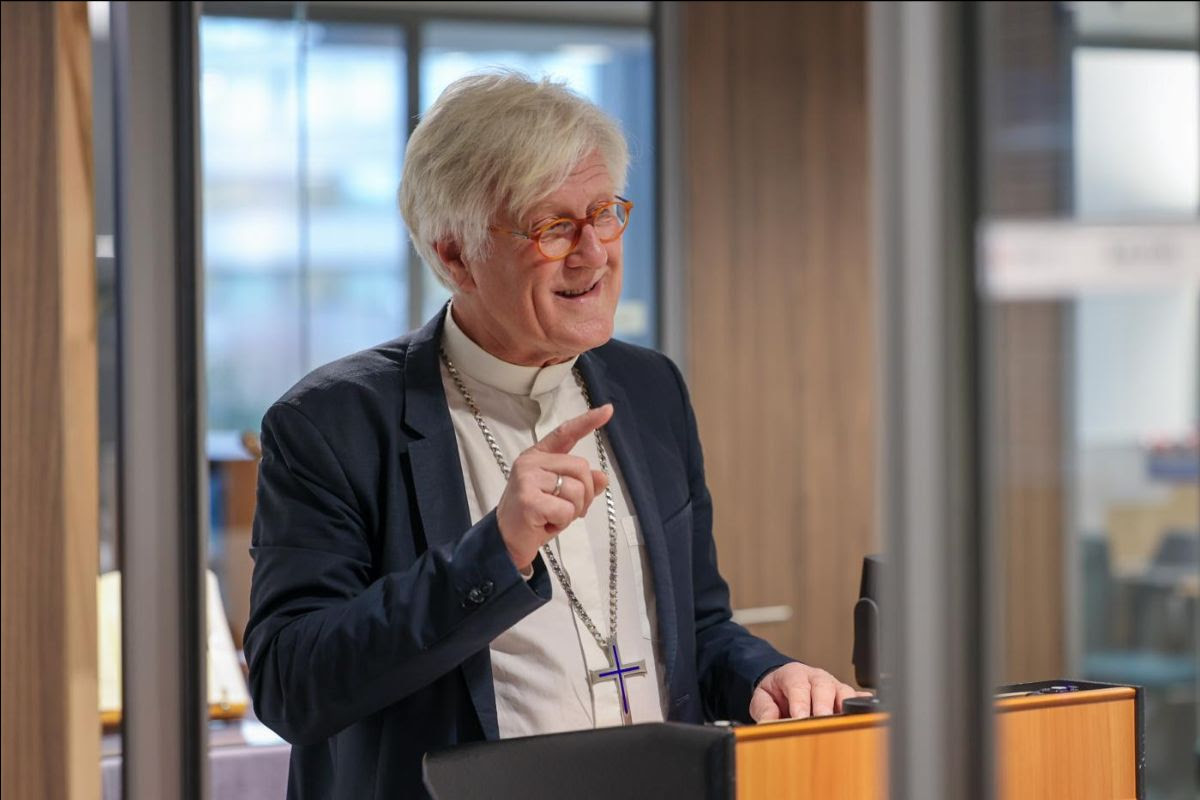
In a landmark gathering addressing the spiritual dimensions of the ecological crisis, Christian leaders from Eastern and Western traditions convened in Assisi, Italy, to develop a shared liturgical Feast of Creation. The three-day conference from 5-7 May marks a significant step toward establishing what Bishop Prof. Dr Heinrich Bedford-Strohm described as "a wonderful expression of the trinitarian essence that unites us as churches" and a powerful spiritual response to the urgent climate challenges facing our planet.
Photo: Einar Tjelle/Church of Norway
06 May 2025

In his introductory address titled "An Ecumenical Dream for the Third Millennium," Bedford-Strohm, moderator of the WCC central committee, set the tone for the gathering, stating: "If the Assisi process continues to develop and reach its goal it might become a landmark in the history of Christianity. Looking back into the second millennium, there seems to be only one precedent: the Feast of the Transfiguration which was originally celebrated in the East and then adopted in the West in 1456."

The conference brought together representatives from 16 world communions including the Anglican Communion, Baptist World Alliance, Roman Catholic Church, Lutheran World Federation, and Eastern Orthodox churches. The discussions will focus on the theological foundations of the feast, lectionary readings, liturgical prayers, and the date, with 1 September being traditionally observed as Creation Day in Eastern Orthodox traditions.

"The Assisi process could be seen as a path, maybe even as a pilgrimage for rediscovering the beauty of the Trinitarian God at work in God's creation," added Bedford-Strohm, highlighting the spiritual dimension of the initiative.

Photo: Einar Tjelle/Church of Norway

Speaking about the ecumenical significance of the gathering, Bedford-Strohm said: "I would not know of any other group of people on this globe who would have a similar potential to encourage the global spiritual reorientation that we so desperately need!"

The conference participants agreed to continue regional dialogues to prepare for implementing the feast in their respective church traditions. Four out of five continental Catholic bishops' conferences have already endorsed the initiative, with many other global church families expressing their support.

"Let us pursue the Assisi process for an ecumenically shared feast of creation as such a witness for unity, so that this ecumenical dream for the third millennium may come true. It will be a strong expression of what Jesus called us to be: salt of the earth and light of the world!" concluded Bedford-Strohm.

The Nicaea Centenary & Creation Day: 2nd Ecumenical Conference on the New Liturgical Feast

Sustainability and Economy of Life

See more
The World Council of Churches on Facebook
The World Council of Churches on Twitter
The World Council of Churches on Instagram
The World Council of Churches on YouTube
World Council of Churches on SoundCloud
The World Council of Churches' website
The World Council of Churches promotes Christian unity in faith, witness and service for a just and peaceful world. An ecumenical fellowship of churches founded in 1948, today the WCC brings together 352 Protestant, Orthodox, Anglican and other churches representing more than 580 million Christians in over 120 countries, and works cooperatively with the Roman Catholic Church. The WCC general secretary is Rev. Prof. Dr Jerry Pillay from the Uniting Presbyterian Church in Southern Africa.

Media contact: +41 79 507 6363; www.oikoumene.org/press
Our visiting address is:
World Council of Churches
Chemin du Pommier 42
Kyoto Building
Le Grand-Saconnex CH-1218
Switzerland

Wednesday, January 29, 2025

WCC News: WCC moderator: Nowhere in the world will we apologize for preaching the gospel

Gospel must not be instrumentalized by politics – and churches should never apologize for reading the Bible or for preaching the Gospel, said World Council of Churches (WCC) moderator Bishop Prof. Dr Heinrich Bedford-Strohm during his reflection at a morning prayer on 27 January.
Prof. Dr. Heinrich Bedford-Strohm, moderator of the World Council of Churches central committee providing his reflection at the Ecumenical Centre’s Monday Morning Prayer on 27 January 2025. Photo: Ivars Kupcis/WCC
29 January 2025

During his visit to the WCC offices in Geneva this week, Bedford-Strohm preached at a prayer service with the WCC staff, reflecting on a Gospel reading from Luke 4:14-21. The passage describes Jesus’ sermon in his hometown, Nazareth, sometimes referred to as the inaugural sermon of Jesus.

Inaugural sermons are something very special, said Bedford-Strohm. “I remember my own inaugural sermon in 2011 very well - it has really accompanied me the whole time. And I remember Jerry Pillay's inaugural sermon when we celebrated his inauguration in the chapel in the Ecumenical Centre.”

Besides inaugural sermons, there are also inaugural speeches, made by the leaders of countries – and some of these words have become famous, continuing to inspire generations to come.

“How different was the tone of the inaugural address that we heard last Monday, just a week ago. Not the common good was in the center of the inaugural address of the new president of the United States, but the exclusion of those who are especially vulnerable,” said Bedford-Strohm.

“And then came the bishop - a bishop with a soft and friendly voice, but strong words,” the WCC moderator said, referring to Rt. Rev. Mariann Edgar Budde, the Episcopal bishop of Washington, who made a plea to president Trump during an interfaith service at the Washington cathedral.

“Bishop Mariann Budde spoke truth to power. And what she said was simply the words of the Gospel.”

“This was a historic sermon - it gave new energy, it gave new hope to many people all over the world,” said Bedford-Strohm.

The president requested her to apologize. She didn't apologize. “Nowhere in the world will we apologize for reading the Bible or for preaching the Gospel. Nowhere in the world will we do that,” said the WCC moderator.

This is the Gospel that is free from instrumentalization by politics, stated Bedford-Strohm. 

When we listen to the words of Luke, we recognize what God wants to tell us: “The Spirit of the Lord is upon me because he has anointed me to preach good news to the poor. He has sent me to proclaim release to the captives and recovery of sight to the blind, to set at liberty those who are oppressed, to proclaim the acceptable year of the Lord.”

“Let's listen to these words. They give us a clear direction for our life and a direction that is really shaped by the Gospel and not by external political forces. Let's preach exactly that Gospel, wherever we are in the world,” concluded Bedford-Strohm.

Read the full sermon by bishop Prof. Dr Heinrich Bedford-Strohm on Luke 4:14-21

See more
The World Council of Churches on Facebook
The World Council of Churches on Twitter
The World Council of Churches on Instagram
The World Council of Churches on YouTube
World Council of Churches on SoundCloud
The World Council of Churches' website
The World Council of Churches promotes Christian unity in faith, witness and service for a just and peaceful world. An ecumenical fellowship of churches founded in 1948, today the WCC brings together 352 Protestant, Orthodox, Anglican and other churches representing more than 580 million Christians in over 120 countries, and works cooperatively with the Roman Catholic Church. The WCC general secretary is Rev. Prof. Dr Jerry Pillay from the Uniting Presbyterian Church in Southern Africa.

Media contact: +41 79 507 6363; www.oikoumene.org/press
Our visiting address is:
World Council of Churches
Chemin du Pommier 42
Kyoto Building
Le Grand-Saconnex CH-1218
Switzerland

WCC News: Dr Jean-Daniel Plüss: Who are we to stand in God’s way?

Approaching Pentecost, let us be open to God’s work in our lives in unexpected ways and ask ourselves: are there boundaries of faith in our ...